
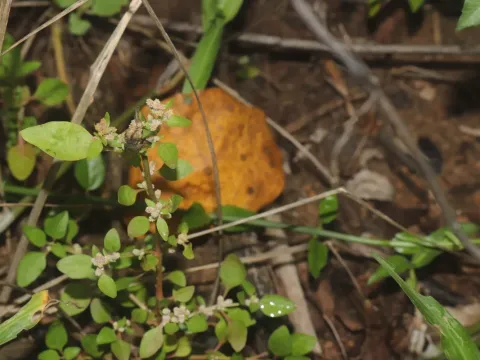
Nothosaerva
Nothosaerva
Nothosaerva is a monotypic genus of flowering plants belonging to the Amaranthaceae family. The only recognized species, Nothosaerva brachiata, is an herbaceous plant widely distributed across tropical regions of Africa and Asia.
What the section contains

Nothosaerva
The plant typically thrives in warm, humid conditions. It is frequently found in agricultural landscapes, particularly in rice paddies and open, disturbed soils where sunlight is abundant. Its adaptation to moisture-rich environments allows it to colonize areas rapidly.
Botanically, Nothosaerva is characterized by small, inconspicuous flowers clustered in spikes. The plant exhibits a branching growth habit, with stems that can be either erect or spreading, which enhances its ability to compete for space and resources.
Cultivation requirements for this species include high temperatures and consistent moisture levels. As a plant native to tropical latitudes, it does not possess significant cold tolerance, which limits its presence to tropical or subtropical zones with stable year-round warmth.
In a formal agricultural sense, Nothosaerva is not a crop but is regarded as an invasive or troublesome weed. It competes with primary crops for soil nutrients, water, and solar radiation, often requiring intervention to protect the yield of cultivated plants.
There is limited documentation regarding specific diseases that affect Nothosaerva exclusively. As a member of the Amaranthaceae family, it can be a host for general agricultural pests, including various types of aphids and foliage-feeding beetles found in tropical regions.
Root system pathogens and water-borne fungi can affect the plant during periods of extreme saturation. However, the species is generally quite resilient and can tolerate various environmental stressors better than many sensitive agricultural crops.
The primary threat from Nothosaerva lies in its potential to overwhelm crop stands. Because it is highly adaptive, it can quickly establish dominance if the cultural practices are not sufficient to suppress weed growth during the early stages of crop development.
Management strategies focus on physical removal and the application of herbicides. Integrated pest management (IPM) is recommended to ensure that the removal of Nothosaerva does not harm the primary crop or the surrounding ecosystem.
The persistence of Nothosaerva seeds in the soil seed bank is a significant factor in its management. Proactive monitoring and multi-year strategies are essential to exhaust the seed bank and prevent the recurrence of the plant in cultivated fields.