
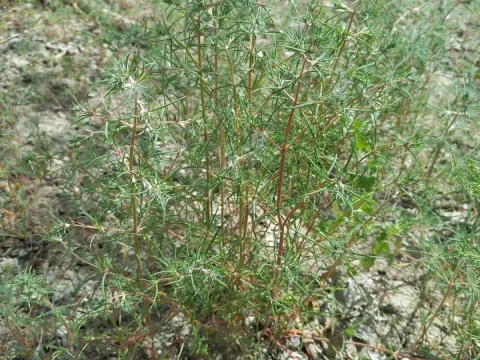
Petrosimonia
Petrosimonia
Petrosimonia belongs to the group of annual halophytic plants that naturally propagate by seeds in late summer and early autumn. Under experimental agronomic conditions, sowing is conducted either before winter or in early spring when the soil retains sufficient moisture after snowmelt.
What the section contains


Petrosimonia
The seeds of the plant exhibit high viability provided they fall into a substrate with moderate salinity. The optimal sowing depth is no more than 1–2 centimeters, which is due to the small size of the seeds and the necessity for rapid germination during spring soil warming.
When cultivating, it is important to consider that Petrosimonia is a typical representative of halophytic flora; therefore, artificial sowing on cultivated non-saline soils often leads to the plant being suppressed by competitive weed species.
The timing of seedling emergence is closely linked to the temperature of the topsoil layer and usually occurs in April or May. During this period, it is critically important to ensure the absence of a dense soil crust that prevents seed germination.
The crop demonstrates high adaptability to sharp temperature fluctuations, which allows it to successfully develop in the continental climate of steppe and semi-desert zones.
This genus of plants is part of the Amaranthaceae family, subfamily Chenopodioideae, and is characterized by a pronounced ability to withstand high concentrations of salts in the soil solution.
The plant prefers solonchaks, solonetz, and other areas with disrupted salt balance, where other agricultural crops cannot form sufficient vegetative mass.
Normal development of Petrosimonia requires high insolation conditions, as the plant is heliophilic and poorly tolerates shading from taller crops or dense vegetation cover.
The soil profile should have good aeration, although many species of the genus withstand temporary waterlogging during the spring flood season in low-lying relief areas.
Basic agronomic requirements include minimizing mechanical soil treatments to avoid destroying the natural structure of the microbiome with which the plant forms symbiotic relationships.
Economic use of Petrosimonia is limited to its role as pasture forage for camels, sheep, and goats in desert and semi-desert areas, where it forms significant biomass.
The yield of green mass strongly depends on the moisture level of a specific growing season and the degree of soil salinity, averaging from 3 to 8 centners of dry matter per hectare in natural cenoses.
With cultivation intensification, the yield potential can be increased by rational distribution of plant density, ensuring optimal use of the available feeding area.
The nutritional value of the plant is preserved even during drought periods, making it a strategic reserve for livestock grazing in late summer when other grasses burn out in the sun.
The economic feasibility of growing Petrosimonia is considered as a method of reclaiming degraded saline lands, combining phytoremediation with the extraction of a forage resource.
Diseases of Petrosimonia are poorly studied due to the lack of widespread industrial adoption, but in natural conditions, it is susceptible to fungal pathogens under excessive humidity.
Among typical pests, specific species of aphids and weevils can be identified, which feed on the succulent tissues of stems and leaves during the plant's active growth period.
The root system can be attacked by nematodes characteristic of saline soils, leading to growth suppression and premature yellowing of the leaf apparatus.
Competition from aggressive weeds is the main threatening factor in the early stages of vegetation, as Petrosimonia gains above-ground mass slowly in the first weeks of life.
Changes in the hydrological regime of a territory leading to soil desalinization can lead to the displacement of Petrosimonia by more competitive mesophytic plant species.
Harvesting or grazing on plots with Petrosimonia is conducted during the flowering or early fruiting phase when the plant is maximally saturated with nutrients.
When harvesting hay, it is important to mow before the stems become fully lignified to maintain acceptable palatability for animals during the winter period.
Mechanized harvesting is complicated by the low height of the herbage and the specific nature of saline soils; therefore, pasture exploitation remains the most justified method of use.
Seed collection for subsequent reseeding is carried out manually or by combines upon fruit maturation, which usually occurs in the second half of autumn.
Special attention should be paid to the purity of the seed material, as Petrosimonia often grows in mixtures with other halophytes in saline conditions, whose seeds may contaminate the final product.