
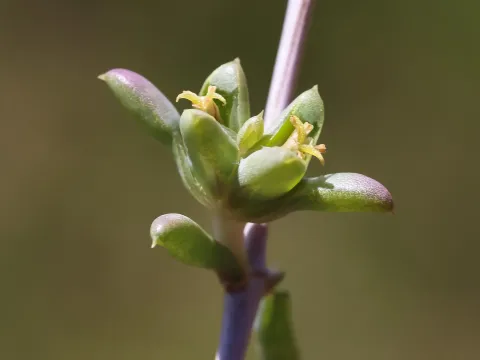
Nucularia
Nucularia
Nucularia, specifically the species Nucularia peruviana, is a perennial subshrub belonging to the Amaranthaceae family. This plant is a typical xerophytic halophyte adapted to life in the extremely dry and saline soil conditions of the desert regions of North Africa and the Atlantic islands.
What the section contains

Nucularia
The crop possesses high ecological plasticity, allowing it to successfully vegetate on substrates with very high levels of mineralization. From an agronomic perspective, the plant is highly demanding regarding solar intensity, as photosynthesis occurs most efficiently at peak temperatures.
Soil preferences for Nucularia are limited to sandy, rocky, or saline soils. The plant is capable of extracting moisture from deep soil layers due to a powerfully developed root system, making it an indispensable component in desertification control projects.
Optimal development for Nucularia requires an arid climate with minimal precipitation. The crop reacts extremely negatively to water stagnation in the root zone and high relative humidity, which can promote the development of fungal infections.
In its natural habitat, Nucularia does not require complex agrotechnology, as it is adapted to nutrient-poor soil. However, when introduced into cultivation, it is important to ensure proper drainage and avoid excessive nitrogen fertilization, which can inhibit the plant's natural salt tolerance mechanisms.
The agricultural use of Nucularia is primarily aimed at forage production in extreme conditions where other crops cannot survive. The plant serves as an important source of green mass for camels, goats, and sheep during dry seasons.
The biomass of Nucularia is characterized by a specific chemical composition, including significant content of mineral salts, which must be considered when formulating animal diets. The green mass yield is highly correlated with groundwater availability and seasonal precipitation patterns.
In addition to its value as forage, Nucularia is used to stabilize shifting sands. Its ability to form dense clusters prevents soil erosion, creating favorable conditions for the establishment of other vegetation species in desert ecosystems.
A promising direction for using Nucularia is its role as a source of phytomass for restoring degraded pastures. Studies indicate that with proper grazing management, the crop is capable of rapid self-regeneration.
The economic efficiency of cultivating this crop is directly linked to the costs of land restoration. Nucularia is a low-input crop, making it attractive for the ecological reclamation of land in regions with arid climates.