
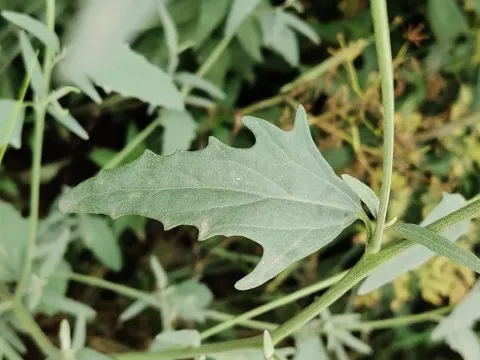
Oblong-leaved orach
Atriplex oblongifolia
Oblong-leaved orach is an annual herbaceous plant belonging to the Amaranthaceae family. Its life cycle is synchronized with the early spring warming period.
What the section contains
Oblong-leaved orach
The seeds are highly adaptable, exhibiting staggered germination, which allows the plant to persist in the seed bank for extended periods of time.
Seedlings typically emerge in April and May, coinciding with the critical early growth stages of many broad-leaved and cereal crops.
The growth rate is notably high, allowing the plant to reach significant size and canopy coverage within a few weeks of emergence.
Rapid canopy development effectively shades the soil surface, suppressing the germination and early development of competing crop plants.
The species thrives in fertile, nitrogen-rich soils, often colonizing disturbed habitats such as agricultural fields and industrial sites.
It exhibits remarkable salt tolerance and can withstand varying levels of soil moisture, making it a persistent colonizer in diverse environments.
High light intensity is essential for the optimal growth of this species, as it does not compete well under low-light canopy conditions.
Soil structure and aeration are important for root penetration, though the plant is capable of growing in compacted soil conditions.
Effective management requires consistent mechanical tillage practices to disrupt growth before the plant achieves reproductive maturity.
Atriplex oblongifolia can serve as a secondary host for several viral diseases, which can later spread to economically important vegetable crops.
Pest populations, including various aphid species and leaf miners, often utilize the plant as a refuge during the off-season.
Fungal pathogens such as powdery mildew may infect the leaves in humid environments, though the plant typically maintains robust vigor.
Herbicide resistance is a growing concern, as many populations have shown reduced sensitivity to conventional control agents.
The main strategy for control involves physical removal or mowing before seed set, as a single plant can produce a vast amount of seeds.