
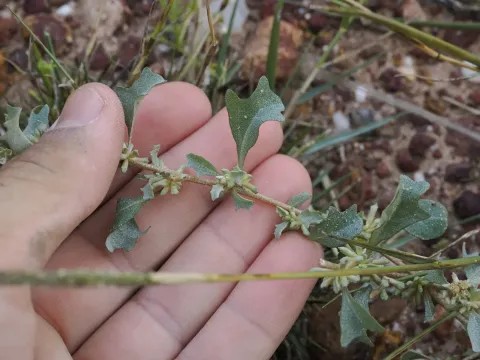
Slender-fruit saltbush
Atriplex leptocarpa
Slender-fruit saltbush, belonging to the Amaranthaceae family, is a highly adaptive species that thrives in various climatic zones once soil temperatures become favorable.
What the section contains
Slender-fruit saltbush
The optimal planting window is generally after the last frost, ensuring the soil has warmed sufficiently to support rapid seed germination and initial establishment.
Seeds are typically sown at a shallow depth, requiring adequate moisture contact for successful emergence within the first two weeks of the growing season.
In large-scale agricultural operations, mechanical seeding is preferred to maintain consistent row spacing and plant density throughout the field.
Successful sowing requires careful site selection to ensure that the area receives full sunlight, which is critical for the developmental speed of this species.
This species is well-recognized for its extreme salt tolerance, making it an ideal candidate for revegetation of degraded or saline-affected agricultural lands.
Its ability to withstand prolonged drought is supported by deep root systems and specialized succulent foliage that minimizes transpiration loss during hot weather.
The plant demonstrates flexibility regarding soil types, performing adequately in both sandy and clay-heavy soils as long as drainage remains functional.
Maintenance involves minimal inputs, as the plant is naturally evolved to survive in nutrient-poor environments where other conventional crops often fail.
While tolerant to adverse conditions, the plant responds positively to occasional moisture during the early vegetative stage to ensure robust biomass accumulation.
Fungal infections, such as powdery mildew, may emerge in humid climates or areas with stagnant air, necessitating proper field management techniques.
Insect pests, including aphids and leaf-eating beetles, are common threats that require monitoring to prevent significant foliage loss during the growth phase.
Effective management includes maintaining a clean field environment by removing host weeds that might harbor pests or diseases throughout the season.
Integrated pest management strategies are recommended to keep damage below economic thresholds without relying solely on chemical pesticides.
Crop rotation practices help in managing soil-borne pathogens and ensuring that the land remains productive for subsequent planting cycles.