
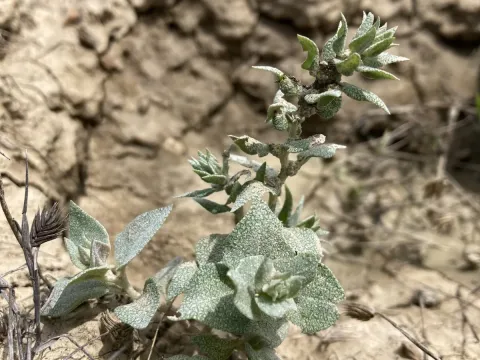
Silverscale saltbush
Atriplex argentea
Silverscale saltbush (Atriplex argentea) is an annual herbaceous plant belonging to the Amaranthaceae family. Its life cycle begins in early spring, when seeds that have overwintered in the soil germinate as temperatures reach 5–8 degrees Celsius.
What the section contains
Silverscale saltbush
For optimal rosette formation and subsequent stem elongation, sowing is recommended in well-warmed, moist soil. The seeds exhibit high germination rates, so they should be sown at a shallow depth, no more than 1–2 centimeters.
The crop is characterized by high growth vigor, allowing it to quickly occupy available space. In agricultural systems, sowing dates are often timed for early spring to take maximum advantage of stored winter moisture.
The growing season lasts about 90–120 days, depending on light conditions and temperature. The plant is capable of self-seeding, which, if uncontrolled, can result in the plant becoming a weed in primary field crops.
Selecting appropriate sowing times ensures the production of high-quality green biomass, which can be utilized for fodder or as a source of bioactive compounds.
Silverscale saltbush is a classic halophyte, capable of growing in saline soils where other plants perish. It demonstrates remarkable plasticity regarding soil composition, preferring loose, sandy, or loamy substrates.
A primary requirement for this crop is direct sunlight. When shaded, the plant loses its characteristic silvery leaf color and significantly reduces its rate of biomass accumulation.
The plant exhibits high drought tolerance due to the unique structure of its leaf epidermis, which is covered with small hairs that reflect excess solar radiation. This makes the plant a promising candidate for cultivation in arid regions.
The optimal pH range for active growth is from neutral to alkaline. The plant copes well with high salt concentrations in the soil solution, a trait that is relatively uncommon among many crop species.
Agrotechnical management requires minimal intervention; however, inter-row cultivation during the initial growth phases helps the crop accumulate vegetative mass faster and suppress the development of undesirable weeds.
The green biomass yield of silverscale saltbush can reach significant levels under favorable moisture conditions. In intensive cultivation, dry matter production constitutes a substantial portion of the total biomass.
When used as a forage crop, the plant is valued for its protein and mineral salt content. Seed yield is also quite high, ensuring the natural regeneration of the population within the field.
Harvesting green biomass is best done before the onset of mass flowering, as this is when the plant contains its peak nutrient concentrations. Delaying harvest leads to stem lignification, which reduces its quality as fodder.
In its natural range, saltbush forms dense stands that serve as a valuable grazing resource during dry seasons. The application of nitrogen fertilizers can significantly increase overall green biomass production.
Yield stability depends on rainfall patterns in the first half of the summer. Despite its resilience, supplemental irrigation during critical growth stages can nearly double its biological productivity.
The primary pests for members of the Atriplex genus include various species of aphids and weevils, which may damage the leaf apparatus. The use of insecticides is advisable only during severe outbreaks.
Saltbush diseases most often manifest as various leaf spots caused by fungal pathogens. Stagnant moisture and lack of aeration in dense stands contribute to the development of these infections.
Powdery mildew can affect the plant during sudden temperature fluctuations and high humidity. Regular monitoring of crop health allows for the early detection of infection clusters and the implementation of timely measures.
Caterpillars of certain lepidopterans can also cause damage by actively feeding on leaves during mid-summer. The plant’s inherent vigor allows it to recover from minor damage without the need for chemical protection.
Proper crop rotation helps reduce the soil's infectious load. It is important to ensure that pathogens common to both saltbush and other cultivated Amaranthaceae family members do not accumulate in the field.