
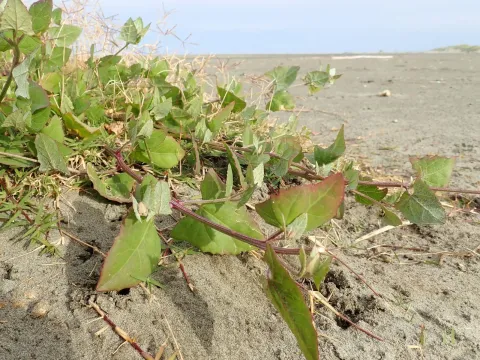
Spreading orache
Atriplex prostrata
The sowing of spreading orache is best performed in early spring as soon as soil temperatures reach 8–10 degrees Celsius, typically in April or early May.
What the section contains
Spreading orache
The seeds have a strong germination energy, which allows for direct field sowing without the need for extensive greenhouse preparation or transplanting.
Standard row planting with 30–45 cm spacing is recommended to ensure adequate space for vegetative development and to facilitate subsequent mechanical weeding.
Seeds should be buried at a shallow depth of 1–2 centimeters, ensuring they remain in contact with moist soil layers to encourage rapid and uniform emergence.
Light soil rolling after sowing can be beneficial in drier climates to improve soil-seed contact and preserve essential moisture in the seed zone.
As a member of the Amaranthaceae family, spreading orache is a notable halophyte, making it highly effective for cultivation on saline lands where other crops struggle.
The plant exhibits remarkable resilience to harsh environmental conditions, including drought and high soil salinity, providing a reliable biomass source in marginal areas.
While not overly demanding regarding soil fertility, it thrives best in well-drained loamy or sandy soils with a neutral pH level for optimal nutrient uptake.
Full sun exposure is crucial for the development of the plant, as it is a light-loving species that does not tolerate shading from taller weeds or canopy coverage.
It adapts well to various temperature fluctuations, maintaining biological activity across a broad range of climates, which simplifies its overall management.
The biomass yield of spreading orache depends heavily on field management and irrigation, typically ranging from 15 to 30 tons per hectare under favorable conditions.
Nitrogen fertilization during early growth stages significantly accelerates biomass accumulation, enhancing the total volume of harvestable green matter for livestock use.
In saline environments where traditional crops might fail, spreading orache proves to be a profitable alternative due to its efficiency in utilizing marginal land resources.
Harvesting at the correct developmental stage ensures a high quality of dry matter, providing essential protein and mineral content for animal feeding regimes.
Strategic irrigation during peak summer growth can boost total yields by 20–40%, making it a viable option for intensive agricultural production systems.
The primary diseases affecting this crop are fungal infections, such as downy mildew, which tend to proliferate in conditions of high humidity and poor air circulation.
Pests like aphids and leaf-eating insects may pose risks during the early vegetative phase, requiring consistent field monitoring and timely intervention if thresholds are exceeded.
Crop rotation remains the most effective strategy to prevent the buildup of soil-borne pathogens, so it is recommended to avoid planting it on the same plot for at least three years.
Good agricultural practices, including effective weed control, improve overall plant health and decrease the humidity levels around the foliage, reducing fungal risk.
Biological control agents are often preferred over chemical pesticides to maintain the ecological integrity of the forage crop and ensure safe usage for livestock.
Harvesting for green fodder should occur before the plant reaches the flowering phase, ensuring the nutrient concentration remains at its peak and stems stay tender.
Mowing at a height of 5–10 centimeters from the ground encourages vigorous regrowth, allowing for multiple cuts within a single growing season under optimal conditions.
Modern forage harvesting equipment is well-suited for this crop, enabling efficient processing for silage production or direct feeding to livestock on the farm.
Seed harvesting requires a separate approach; it should be performed once the seeds are fully mature and firm to minimize losses during collection and drying.
Proper post-harvest management, such as drying in windrows, is essential if the crop is intended for hay, preventing mold and preserving its nutritional quality.