
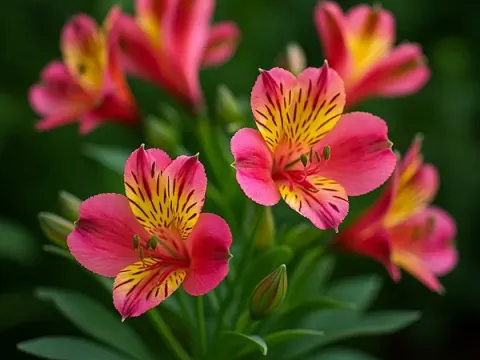
Alstroemeria hybrids
Alstroemeria hybrids
Alstroemeria hybrids belong to the Alstroemeriaceae family. This perennial rhizomatous plant requires specific planting schedules to achieve optimal vegetative development and bloom production.
What the section contains
Alstroemeria hybrids
Propagation is most commonly performed vegetatively by dividing rhizomes, which preserves the hybrid's unique traits. The optimal period for division and planting into greenhouses is late winter or early spring.
For seed propagation, sowing is carried out during winter months as seeds require a stratification period for successful germination. Seeds are sown in light substrate, and seedlings are transplanted once they reach the 3-4 leaf stage.
In industrial greenhouses, planting is planned according to photoperiod requirements. Early root establishment before the onset of hot summer months is crucial for proper flower bud initiation.
Temperature during the first weeks after planting should be maintained between 15-18 degrees Celsius, which promotes active root system development without excessive shoot elongation.
This crop has high demands for soil quality. The growing medium must be light, rich in organic matter, well-drained, and have a pH level between 5.5 and 6.5 to prevent iron chlorosis.
Light levels are a determining factor for flowering. Alstroemeria requires intense light, but shade is necessary during peak summer hours to prevent soil overheating, which can lead to plant dormancy.
Soil temperature is a critical parameter: if it rises above 20-22 degrees Celsius, the plant stops flowering. Professional growers use advanced substrate cooling systems to maintain vigor.
Irrigation should be regular but avoid waterlogging. Excessive moisture at low temperatures quickly provokes rhizome rot, making drip irrigation systems the industry standard for controlled moisture delivery.
Balanced fertilization is essential. During the vegetative stage, nitrogen-based fertilizers are prioritized, while shifting to high-potassium and phosphorus ratios during bud formation ensures strong stems.
The yield of Alstroemeria hybrids depends directly on light intensity and temperature stability. In professional greenhouse conditions, one plant can produce between 10 to 20 flowering stems per season.
The productive life of a planting bed typically lasts 3-4 years. After this period, rhizomes become overcrowded and productivity declines, necessitating the renewal of the planting stock.
Hybrid varieties vary significantly in blooming cycles and vigor. Selecting the right hybrid allows growers to program harvests for specific dates, which is vital for market profitability.
Quality of cut flowers is measured by stem length and the number of buds per inflorescence. Proper agronomic practices allow for the production of stems up to 80-100 cm with dense floral displays.
Under intensive cultivation, harvesting is performed daily, as buds open sequentially, ensuring a continuous supply of market-ready products throughout the growing season.
The main threats to the crop include fungal diseases of the root system, such as Fusarium and Phytophthora. These are often triggered by excessive soil moisture and poor ventilation within the greenhouse.
Grey mold (Botrytis) frequently affects leaves and flowers in high-humidity conditions. Regular ventilation and preventative fungicide applications are mandatory to protect the crop.
Pests such as thrips and spider mites pose significant risks. They reproduce rapidly in warm conditions and can quickly diminish the market value of the cut flowers.
Aphids can also cause considerable damage by acting as vectors for viral infections, for which there are no effective chemical cures, necessitating the removal of infected plants.
- Strict crop rotation and tool disinfection.
- Regular monitoring for early signs of disease or pest infestation.
- Integrated pest management using biological controls alongside targeted insecticides.
Harvesting Alstroemeria is unique: stems are not cut with a knife but are pulled from the base of the rhizome. This technique stimulates the plant to produce new shoots and prevents stem rot.
The optimal harvest phase is when the first 1-2 flowers on the inflorescence are open. This stage ensures maximum vase life and durability during transport for the end consumer.
After harvesting, stems are graded by length and quality. It is crucial to prevent foliage damage, as hybrid leaves should remain vibrant green and firm throughout the storage period.
To extend vase life, special preservatives are used to prevent bacterial growth in the water and improve vascular conductivity. Storage temperature should be kept between 2-5 degrees Celsius.
Flowers are packed in an upright position to prevent stem bending due to geotropism, which could otherwise reduce the commercial value of the final product.