
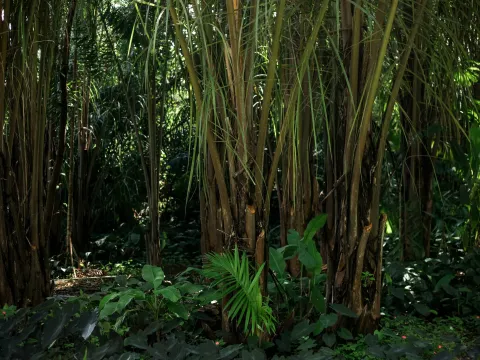
Raphia
Raphia
Raphia is a genus of monocotyledonous palms in the family Arecaceae. Propagation primarily occurs through seeds, which often possess a thick coat that requires specific treatments to break dormancy.
What the section contains


Raphia
In nurseries, seeds are sown in a rich, organic substrate under high-humidity conditions. The germination period is notably long, sometimes lasting up to a year, necessitating patient management.
Once seedlings have developed a strong root system and their first true leaves, they are ready for transplanting. Site preparation requires deep, nutrient-dense soil to accommodate the rapid initial growth.
Optimal spacing is crucial to prevent competition for light and water as the palms mature. In their natural habitat, they are often found in clusters, but agricultural systems favor structured rows for easier maintenance.
Young plants benefit from filtered light, mimicking the environment of the forest canopy, before they transition to full sun exposure in later growth stages.
Raphia thrives in hot, humid tropical climates where temperatures remain consistently above 25 degrees Celsius throughout the year. It does not tolerate frost or prolonged drought.
Water availability is the most critical factor. Many species are semi-aquatic, growing naturally along riverbanks or in swampy, low-lying areas where water tables are constantly high.
Soil composition should be high in organic matter, as these palms rely on nutrient-rich environments to support their massive leaf production. Drainage must be balanced to prevent stagnant conditions that lead to root rot.
The plant requires significant space to accommodate its leaves, which are among the largest in the plant kingdom, sometimes reaching lengths of 20 meters.
Regular fertilization with balanced nutrients, focusing on nitrogen for leaf growth, is essential for maintaining a high yield in commercial fiber plantations.
The economic value of Raphia stems primarily from its leaves, which yield a strong, flexible fiber known as raffia. Productivity is measured by the quantity and quality of the fiber extracted from the epidermis.
Sustainable harvesting of leaves allows for continuous production over the lifespan of the palm. Over-harvesting must be avoided to ensure the plant maintains enough energy for apical growth.
Fiber quality is categorized by length and tensile strength. Premium fibers are used for high-end textile and basketry production, while shorter fibers serve industrial packaging needs.
In addition to fiber, the pith of the stem contains starch, which provides a secondary product, increasing the overall agricultural utility of the palm.
Efficient on-site processing is standard to ensure the freshness of the material, as the leaf epidermis loses its pliability if left too long before extraction.
Fungal pathogens represent the most significant threat to Raphia, particularly those that target the root system in poorly drained soils or during periods of environmental stress.
Palm weevils are a major pest; their larvae bore into the trunk and apical meristem, often causing irreversible damage and the death of the plant.
Defoliating insects can reduce the leaf surface area, impacting photosynthesis and ultimately leading to weaker, lower-quality fiber production.
Nutrient deficiencies, specifically in trace minerals, can lead to chlorosis and stunted leaf development, making the plant more susceptible to opportunistic diseases.
- Conducting routine phytosanitary checks to detect pest activity early.
- Removing and destroying infected plant tissue to stop disease spread.
- Maintaining optimal water levels to balance soil health and oxygenation.
Harvesting is a manual process involving the careful cutting of individual leaves at the base. Great care is taken not to damage the crown or the growing tip of the palm.
Extraction of the fiber involves peeling the epidermis from the leaf surface. This must be done while the leaves are fresh to ensure the fiber remains pliable and easy to work with.
Drying is a critical post-harvest step. The fibers are air-dried in shaded areas to preserve their natural color and prevent the brittleness that occurs with sun-bleaching or rapid dehydration.
Once dried, the fibers are bundled, sorted by grade, and prepared for distribution. Proper storage in dry, well-ventilated areas is essential to prevent mold growth during transport.
By-products, such as the woody leaf rachis, are often utilized as construction material or burned to provide ash for soil enrichment in local farming systems.