
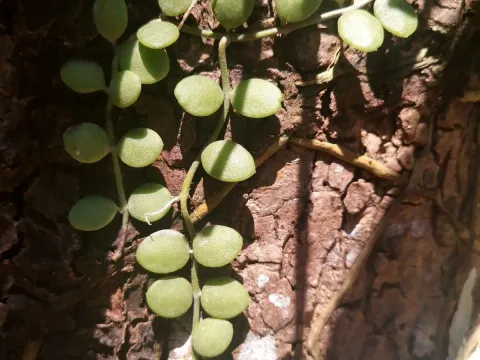
Dischidia
Dischidia
Dischidia is a genus of perennial epiphytic plants belonging to the Apocynaceae family. In their natural habitat, they are native to the tropical forests of Southeast Asia, Australia, and Oceania, where they grow as epiphytes or lithophytes.
What the section contains
 Dischidia
 hybrids
Dischidia acutifolia
Dischidia acutifolia
Dischidia
Dischidia hybrids
Dischidia acutifolia
Dischidia acutifolia
 Dischidia cleistantha
Dischidia cleistantha
Dischidia cleistantha
 Dischidia imbricata
Dischidia imbricata
Dischidia imbricata
 Dischidia major
Dischidia major
Dischidia major
 Dischidia oiantha
Dischidia oiantha
Dischidia oiantha
 Dischidia ovata
Dischidia ovata
Dischidia ovata
 Dischidia parasitica
Dischidia parasitica
Dischidia parasitica
 Dischidia platyphylla
Dischidia platyphylla
Dischidia platyphylla
 Dischidia vidalii
Dischidia vidalii
Dischidia vidalii
 Hairy Dischidia
Dischidia hirsuta
Hairy Dischidia
Dischidia hirsuta
Dischidia
A botanical hallmark of this genus is the presence of fleshy leaves, which are often modified into pitcher-like structures or hollow chambers. These specialized organs store water and nutrients, enabling the plant to thrive in nutrient-poor environments with limited access to substrate.
The culture requires specific environmental conditions, favoring bright indirect light and high humidity levels. In indoor settings, Dischidia performs best when temperatures are maintained consistently between 20°C and 25°C.
A lightweight, highly porous substrate is essential for the healthy growth of Dischidia. Growers typically use mixtures composed of pine bark, sphagnum moss, charcoal, and perlite to ensure excellent aeration and prevent root rot.
Good agricultural practice involves moderate watering after the top layer of the substrate has dried out, coupled with regular misting. The plant responds positively to balanced fertilizers designed for epiphytes, applied at half-strength during the growing season.
The primary pests affecting Dischidia include sucking insects such as mealybugs, spider mites, and scale insects, which frequently infest the plant when humidity levels are kept too low.
Fungal and bacterial diseases are typically associated with improper watering regimes that lead to waterlogging of the root zone. Ensuring adequate drainage and airflow is crucial to minimizing these risks.