
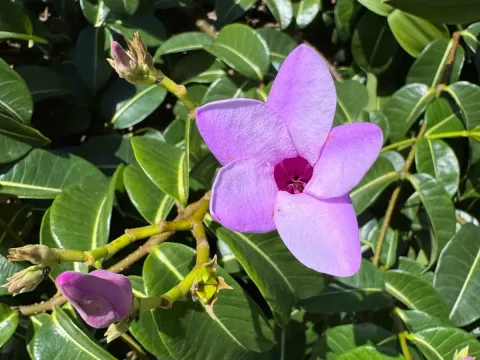
Cryptostegia
Cryptostegia R. Br.
Industrial cultivation of Cryptostegia is primarily initiated through seeds, which require high soil temperatures to germinate successfully. In tropical environments, the optimal sowing time is typically just before the onset of the rainy season, ensuring young seedlings have access to sufficient moisture.
What the section contains

Cryptostegia
Seed preparation may include soaking in warm water to accelerate embryo germination. Seeds should be planted at a shallow depth of 1–2 centimeters to ensure that the emerging shoots reach the surface without difficulty.
Both direct sowing and nursery-raised transplants are employed for establishing plantations. Transplanting requires significant care, as the root systems are sensitive to mechanical stress and damage during the movement from nursery to field.
Planting density varies depending on the intended use and the harvesting method. Generally, spacing of 1.5–2 meters between rows is maintained to ensure each shrub receives adequate sunlight and air circulation.
Weed management is critical during the initial months, as Cryptostegia exhibits slow early growth and is highly susceptible to competition from weeds for vital sunlight and soil nutrients.
Cryptostegia belongs to the Apocynaceae family and is a perennial woody vine or shrub known for its high growth potential under optimal conditions. Originally native to Madagascar, it has naturalized in numerous tropical and subtropical regions worldwide.
To reach full development, the crop requires temperatures consistently above 20–25 degrees Celsius throughout the growing season. The plant is extremely sensitive to frost and low temperatures, which can prove fatal to the above-ground biomass.
The plant is relatively undemanding regarding soil quality, though it performs best in well-drained loams and sandy soils with neutral or slightly acidic pH levels. Waterlogging in the root zone is a critical limiting factor that frequently leads to root decay.
Cryptostegia exhibits moderate drought tolerance once its root system is well-established in the soil. However, for industrial latex production, a reliable irrigation schedule is recommended during dry spells to maintain productivity.
Sunlight exposure is essential for the crop. In shaded conditions, the growth rate of the vines decreases significantly, and the concentration of milky latex within the stems drops, negatively impacting the quality and volume of the harvest.
The primary economic product of Cryptostegia is its latex, which is distributed throughout the plant's stems and leaves. Historically, it was investigated as a viable alternative source for natural rubber during global supply shortages of the Hevea tree.
The rubber content in the dry matter of the stems can be substantial, though the extraction process is technologically complex. Total yield is determined by the age of the plants and the intensity of the agronomic management applied to the plantation.
Industrial exploitation involves periodic pruning of the shoots, which contain the highest concentrations of milky sap. Established plantations can remain productive for several years before needing rejuvenation or replacement.
Modern processing techniques involve grinding the harvested green biomass followed by coagulation of the extracted latex. The final output depends heavily on the specific selection of the plant variety and the environmental conditions of the region.
Beyond rubber extraction, Cryptostegia is sometimes utilized for landscaping and soil erosion control, thanks to its ability to rapidly generate significant biomass in suitable climates.
Cryptostegia is naturally resistant to many pests due to the presence of toxic alkaloids and sap in its tissues, which acts as a deterrent. This makes it inherently more robust than many other commercial technical crops.
In intensive farming, infestations of sucking insects such as aphids or scale insects may occur, specifically targeting young, tender shoots. Regular monitoring of leaf health is essential for early detection and mitigation of outbreaks.
Fungal diseases are typically associated with poor agronomic practices, particularly over-irrigation or inadequate ventilation within the plantation. Prevention is best achieved through proper row spacing and effective soil drainage.
Root rot represents a severe threat capable of destroying large areas of cultivation. To avoid these issues, nitrogen fertilizer applications should be strictly controlled, as excessive nitrogen can lead to overly succulent, vulnerable plant tissues.
Because Cryptostegia can become invasive if left unmanaged, plantations must implement strict measures to control self-seeding and prevent the spread of vines beyond the designated cultivation areas.