

Reference · Crops
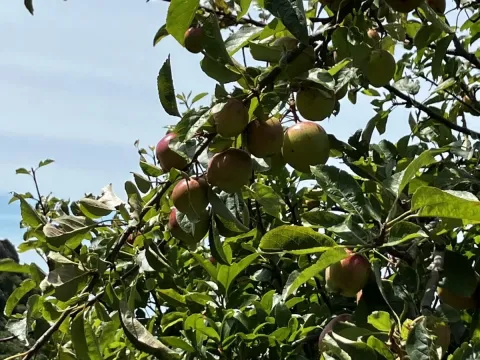
Apple tree
Malus Mill.
Apple trees (*Malus Mill.*), belonging to the *Rosaceae* family, are typically planted during their dormant phase in early spring or late autumn. The timing depends on regional climate conditions, ensuring the plant has enough time to establish roots before extreme temperatures occur.
24
items
What the section contains
 Apple
Malus domestica (Suckow) Borkh.
1 368 products
Apple
Malus domestica (Suckow) Borkh.
1 368 products
 Adstringent apple
Malus xadstringens Zabel
Adstringent apple
Malus xadstringens Zabel
 Astrakhan apple
Malus x astracanica hort. ex Dum. Cours.
Carmine crabapple
Malus x atrosanguinea (hort. ex Späth) C. K. Schneid.
Astrakhan apple
Malus x astracanica hort. ex Dum. Cours.
Carmine crabapple
Malus x atrosanguinea (hort. ex Späth) C. K. Schneid.
 Crab apple
Malus sylvestris (L.) Mill.
Crab apple
Malus sylvestris (L.) Mill.
 Cutleaf crabapple
Malus transitoria (Batalin) C. K. Schneid.
Flowering crabapple
Malus domestica x Malus robusta
Cutleaf crabapple
Malus transitoria (Batalin) C. K. Schneid.
Flowering crabapple
Malus domestica x Malus robusta
 Flowering crabapple
Malus domestica (Suckow) Borkh. x M. sargentii Rehder
Gloriosa crabapple
Malus x gloriosa Lemoine
Flowering crabapple
Malus domestica (Suckow) Borkh. x M. sargentii Rehder
Gloriosa crabapple
Malus x gloriosa Lemoine
 Hupeh crabapple
Malus hupehensis (Pamp.) Rehder
Hybrids of Malus domestica and Malus prunifolia
hybrids between Malus domestica Borkh. and Malus prunifolia (Willd.) Borkh.
Hupeh crabapple
Malus hupehensis (Pamp.) Rehder
Hybrids of Malus domestica and Malus prunifolia
hybrids between Malus domestica Borkh. and Malus prunifolia (Willd.) Borkh.
 Hybrids of Malus domestica and Malus x purpurea
hybrids between Malus domestica Borkh. and Malus x purpurea (A. Barbier) Rehder
Hybrids of Malus domestica and Malus x purpurea
hybrids between Malus domestica Borkh. and Malus x purpurea (A. Barbier) Rehder
 Japanese flowering crabapple
Malus floribunda Siebold ex Van Houtte
Japanese flowering crabapple
Malus floribunda Siebold ex Van Houtte
 Paradise apple
Malus pumila L. Mill.
Paradise apple
Malus pumila L. Mill.
 Plum-leaved apple
Malus prunifolia (Willd.) Borkh.
Purple crabapple
Malus x purpurea (A. Barbier) Rehder
Purple transition apple
Malus x purpurea x Malus transitoria
Robust apple
Malus x robusta (Carrière) Rehder
Plum-leaved apple
Malus prunifolia (Willd.) Borkh.
Purple crabapple
Malus x purpurea (A. Barbier) Rehder
Purple transition apple
Malus x purpurea x Malus transitoria
Robust apple
Malus x robusta (Carrière) Rehder
 Sargent crabapple
Malus sargentii Rehder
Sargent crabapple
Malus sargentii Rehder
 Siberian crabapple
Malus baccata (L.) Borkh.
Siebold's crabapple
Malus toringo (Siebold) Siebold ex de Vriese
Sievers' apple
Malus sieversii (Ledeb.) M. Roem.
Siberian crabapple
Malus baccata (L.) Borkh.
Siebold's crabapple
Malus toringo (Siebold) Siebold ex de Vriese
Sievers' apple
Malus sieversii (Ledeb.) M. Roem.
 Yunnan crabapple
Malus yunnanensis (Franch.) C. K. Schneid.
Yunnan crabapple
Malus yunnanensis (Franch.) C. K. Schneid.
 Zumi apple
Malus zumi (Matsum.) Rehder
Zumi apple
Malus zumi (Matsum.) Rehder
Marketplace
Products in this section · 12


Apple tree
Spring planting is highly recommended for colder climates, allowing the tree to settle in before the winter freeze. It must be performed before the buds begin to swell to ensure the sap flow is directed toward establishing a new root system rather than foliage development.
Autumn planting is favorable in milder regions, as the moist soil and moderate temperatures promote root regeneration before the winter dormancy. However, it is crucial to mulch the base of the tree to prevent frost heave and protect young, sensitive roots.
Correct spacing is essential for orchard layout, determined by the rootstock's vigor and the chosen training system. Dwarfing rootstocks allow for high-density plantings, while vigorous standards require significantly more space to ensure adequate light penetration.
As most varieties are cross-pollinating, it is vital to plant compatible cultivars with overlapping blooming periods in the same vicinity. This biodiversity is essential for ensuring successful fertilization and maximizing the fruit set per tree.
Apple trees thrive in full sunlight, requiring at least six to eight hours of direct light daily. Exposure to light is critical for photosynthesis, which directly influences sugar content, fruit flavor, and color development.
They prefer deep, fertile, and well-drained loamy or sandy-loam soils with a slightly acidic to neutral pH. Poorly drained soil leads to root rot, so orchards should ideally be located on slightly elevated sites to prevent water stagnation around the base.
Consistent water management is necessary throughout the growing season, especially during fruit set and enlargement. Drought stress can cause premature fruit drop and reduce fruit size, while excessive irrigation can lead to oxygen starvation in the roots.
Pruning is a fundamental aspect of apple tree maintenance, aimed at improving air circulation, light access, and structural integrity. A well-pruned tree is less prone to moisture-related diseases and easier to harvest than an unmanaged, dense canopy.
A balanced fertilization program based on annual soil testing is required to meet the plant's nutritional needs. Essential nutrients, particularly nitrogen for vegetative growth and potassium for fruit quality, should be applied at specific growth stages.
The yield of an apple tree is heavily influenced by the genetic potential of the variety, the quality of the rootstock, and the management practices employed. Modern intensive orchards can produce 40 to 80 tons per hectare under optimal conditions.
Depending on the rootstock, trees may begin producing fruit as early as 3–5 years after planting. Full productive capacity is usually reached after the first decade, necessitating proactive management to sustain high yields over the orchard's lifespan.
Biennial bearing, where a tree produces a heavy crop one year and very little the next, is a common challenge. Thinning excess fruit during the heavy-crop year is a key technique used to regulate the tree and ensure consistent production cycles.
Quality parameters, such as fruit size, sugar content (Brix), and firmness, are dictated by both variety and crop load. Effective thinning ensures that energy is directed into producing premium-quality, marketable fruit rather than an abundance of small ones.
Post-harvest management is the final step in ensuring yield profitability. Implementing advanced storage solutions, such as cold chain logistics and controlled-atmosphere storage, preserves the quality of the harvest for market distribution over several months.
Apple scab, caused by the fungus *Venturia inaequalis*, is one of the most destructive diseases, impacting both yield and fruit marketability. Management involves systemic fungicides and rigorous sanitation by removing overwintering infected leaves.
Powdery mildew appears as white, dusty patches on leaves and shoots, stunting growth and reducing the tree's vigor. Integrated pest management, including pruning affected parts and using resistant cultivars, is the most effective way to keep infection rates low.
The codling moth is a primary pest whose larvae tunnel directly into the fruit, making them unsalable. Growers often use pheromone traps for monitoring and targeted insecticide applications to disrupt the moth's life cycle during peak activity.
Aphids and mites can weaken trees by feeding on succulent foliage, which creates stress and reduces photosynthetic efficiency. Regular scouting for these pests allows for early intervention before populations reach levels that cause significant economic damage.
Fire blight is a highly contagious bacterial disease that can destroy branches or entire trees rapidly. Control involves immediate removal and destruction of infected wood, followed by strict disinfection of pruning tools to prevent the pathogen from spreading.
Harvesting strategies are categorized by maturity indices, ensuring the fruit is picked at the correct stage for its intended use—either immediate consumption or long-term storage. Testing for starch conversion and sugar levels is standard procedure.
Careful handling is required during manual harvest to prevent skin punctures or bruising, which are points of entry for rot-inducing pathogens. Each fruit must be picked gently, preserving the stem to minimize physiological stress.
Sorting and grading based on size, color, and lack of blemishes are performed to maintain quality standards. Properly graded fruit fetches higher prices and is more resilient during shipment to wholesale or retail markets.
Rapid cooling after harvest is mandatory to extend the shelf life and preserve the fruit's internal quality. By reducing the core temperature to near 0°C, the respiration rate is lowered, effectively slowing down the natural ripening process.
Using ventilated crates for transport and storage prevents gas buildup, specifically ethylene, which can cause premature softening of the fruit. Maintaining the cold chain is the most significant factor in reducing post-harvest waste and maximizing revenue.