
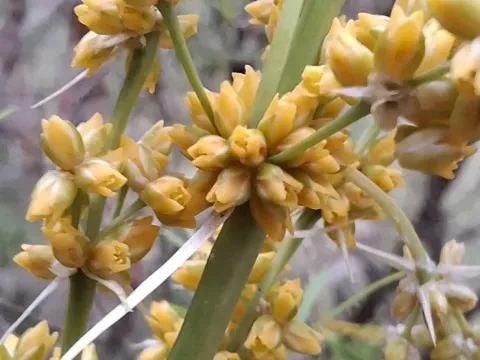
Lomandra
Lomandra Labill
Lomandra (Lomandra Labill) is a perennial evergreen herbaceous plant belonging to the Asparagaceae family. Native to Australia, it has evolved to thrive in diverse environments, ranging from sandy dunes to rocky outcrops, making it a highly resilient species.
What the section contains
 Lomandra
 longifolia x Lomandra confertifolia
Lomandra
Lomandra longifolia x Lomandra confertifolia
 Lomandra confertifolia
 (F. M. Bailey) Fahn
Lomandra confertifolia subsp. rubiginosa
Lomandra confertifolia (F. M. Bailey) Fahn subsp. rubiginosa A. T. Lee
Lomandra confertifolia subspecies pallida
Lomandra confertifolia (F. M. Bailey) Fahn subsp. pallida A. T. Lee
Lomandra confertifolia
Lomandra confertifolia (F. M. Bailey) Fahn
Lomandra confertifolia subsp. rubiginosa
Lomandra confertifolia (F. M. Bailey) Fahn subsp. rubiginosa A. T. Lee
Lomandra confertifolia subspecies pallida
Lomandra confertifolia (F. M. Bailey) Fahn subsp. pallida A. T. Lee
 Lomandra hystrix
 (R. Br.) L. R. Fraser & Vickery
Lomandra hystrix
Lomandra hystrix (R. Br.) L. R. Fraser & Vickery
 Lomandra longifolia
Lomandra longifolia
Lomandra longifolia
 Lomandra patens
 A. T. Lee
Lomandra patens
Lomandra patens A. T. Lee
 Lomandra spicata
Lomandra spicata
Lomandra spicata
 Many-flowered mat-rush
Lomandra multiflora (R. Br.) Britten
Many-flowered mat-rush
Lomandra multiflora (R. Br.) Britten
 Mountain lomandra
Lomandra montana (R. Br.) L. R. Fraser & Vickery
Mountain lomandra
Lomandra montana (R. Br.) L. R. Fraser & Vickery
 River lomandra
Lomandra fluviatilis (R. Br.) A. T. Lee
River lomandra
Lomandra fluviatilis (R. Br.) A. T. Lee
 Wattle mat-rush
Lomandra filiformis (Thunb.) Britten
Wattle mat-rush
Lomandra filiformis (Thunb.) Britten
Lomandra
The plant features tufted, linear, and often tough leaves that resemble ornamental grasses. Its root system is exceptionally robust, designed for efficiency in moisture uptake and storage, which contributes to the plant's legendary drought tolerance.
Climate-wise, Lomandra prefers sunny locations but is highly adaptable to partial shade. It is well-suited for regions with significant temperature fluctuations, maintaining its structural integrity and green foliage throughout the seasons.
Soil requirements for Lomandra emphasize excellent drainage. While it is not demanding regarding soil fertility, it suffers significantly in waterlogged conditions, which can lead to root degradation and decline in vigor.
In agricultural and landscape applications, Lomandra is highly valued for its low-maintenance profile. It is extensively used in erosion control, as a ground cover, and as a focal point in contemporary landscape design, especially in water-wise gardening (xeriscaping).
The primary threats to Lomandra health are fungal root diseases, primarily caused by excessive moisture or poor soil drainage. Maintaining a well-aerated soil structure is the most effective preventative measure against these infections.
Pests are generally not a major concern for outdoor plantings due to the plant's tough, fibrous leaf structure, though scale insects or mealybugs can occasionally become an issue in confined or greenhouse conditions.
If environmental conditions become overly humid, there is a risk of minor fungal spotting on the foliage. Proper spacing during planting is essential to allow for adequate airflow and to prevent such issues from developing.
Integrated pest management should focus on cultural practices first, such as pruning away damaged foliage and ensuring the plant receives adequate light. These steps help maintain the plant's natural resistance to environmental stress.
Chemical intervention should be considered only as a last resort. Always prefer targeted biological treatments and ensure that the irrigation system is correctly calibrated to provide only the necessary amount of water required by the plant.