
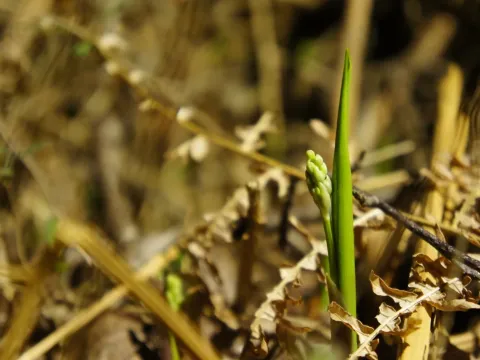
Lily of the valley
Convallaria L.
Propagation of lily of the valley in both commercial and ornamental contexts is primarily carried out vegetatively using rhizome cuttings with an apical bud. The optimal time for establishing plantations is during the autumn period (September-October), which allows the root system to adapt before the onset of persistent frosts.
What the section contains

Lily of the valley
Spring planting of propagation material is also permitted, but in this case, it is necessary to provide regular watering so that the plants have time to establish before the onset of summer heat. Planting is conducted using row methods with row spacing of up to 20-25 cm.
Seed propagation in agricultural practice is rarely used due to the extremely low germination rate of seeds and the long development period of seedlings. Sprouts appear unevenly, and flowering occurs only in the fifth to seventh year of the plant's life.
The planting depth of rhizomes should not exceed 2-3 cm. It is important that the apical bud remains at the soil surface level or is only slightly covered with loose substrate, otherwise, shoot development will be hindered.
When planning plantings, it is necessary to consider the culture's high capacity for aggressive spreading, so areas should be bordered with edges or special sunken ribbons to control the growth area.
Lily of the valley belongs to the Asparagaceae family (formerly included in the Liliaceae family) and is a perennial herbaceous rhizomatous plant. In nature, the crop prefers moderately moist areas, partial shade, and forest soils rich in humus.
For agronomic cultivation, loamy soils with a neutral or slightly acidic reaction are most suitable. It is important to provide good drainage, as stagnant moisture in the autumn-winter period inevitably leads to rhizome rotting.
The crop has moderate climate requirements, possessing high winter hardiness characteristic of temperate zone plants. The optimal temperature range for active shoot growth in spring is +15...+20 degrees Celsius.
Fertilizer application should be carried out in spring at the beginning of active vegetation and in autumn after the above-ground part dies off. Preference is given to organic components, such as well-decomposed compost or leaf mold, which improve soil structure.
An important requirement is the observance of light intensity: under direct sunlight, the plant becomes smaller, and flowering becomes less intense. When grown in a garden or on a plantation, placing it under the canopy of trees or shrubs is considered ideal.
The economic use of lily of the valley is primarily related to its value as a medicinal raw material. The herb (above-ground part) and inflorescences containing cardiac glycosides, used in pharmacology for the production of cardiological preparations, are subject to harvesting.
Biomass yield depends heavily on soil composition and the age of the plantation. Under intensive conditions, significant amounts of raw material can be obtained from one hectare, although industrial harvesting is strictly regulated by legislation to conserve the population.
In ornamental horticulture, yield is assessed by the number of flower stalks per square meter. With proper agronomy and regular plantation rejuvenation, the figure reaches 30-50 inflorescences, making the crop highly profitable for early forcing.
Lily of the valley forcing is a popular direction in the floral business, allowing for the production of blooming goods for holidays during the winter season. For these purposes, specially prepared rhizomes that have gone through a deep dormancy period are used.
The economic efficiency of growing lily of the valley directly correlates with the quality of planting material and the level of labor mechanization during harvesting and sorting of raw materials, which is a key factor for commercial farms.
The main phytopathological disease of lily of the valley is gray mold (Botrytis), which affects leaves and inflorescences in conditions of high humidity and poor ventilation. Affected areas are covered with a characteristic gray coating.
Root rot, caused by soil fungal pathogens, poses a serious threat when drainage management is violated. Prevention consists of observing crop rotation and avoiding over-wetting of plantations.
Among pests, nematodes cause the most damage, leading to leaf deformation and stunted plant growth. Controlling them is difficult, so the primary protection method remains the careful selection of healthy planting material.
The lily leaf beetle can also damage leaf blades by chewing holes in them. To combat this pest, contact insecticides or manual collection of insects on small plots are used.
It is important to remember the high toxicity of all parts of the plant to humans and animals, which requires strict adherence to safety precautions when working with the crop and conducting pest and disease treatments.
Medicinal raw material is harvested at the beginning of the mass flowering period, when the inflorescences are already fully opened. It is at this moment that the concentration of active substances (glycosides) in the plant tissues reaches its maximum.
Harvesting the herb is carried out at a height of 3-5 cm from the soil surface, using sharp knives or sickles. It is important not to damage the root system to ensure regeneration and productivity of the plantation in subsequent years.
Harvested raw materials must be delivered to the drying site as quickly as possible, as they are prone to rapid self-heating and spoilage. The optimal drying method is active ventilation dryers at temperatures not exceeding 50-60 degrees Celsius.
When harvesting flowers for forcing, rhizomes are dug up in autumn, after the natural die-off of the above-ground parts. Rhizomes are dug, sorted by apical bud size, and stored in cool premises.
Proper organization of harvesting allows maintaining plantation viability for up to 10 years without the need for complete replanting, which significantly reduces operating costs in long-term crop cultivation.