
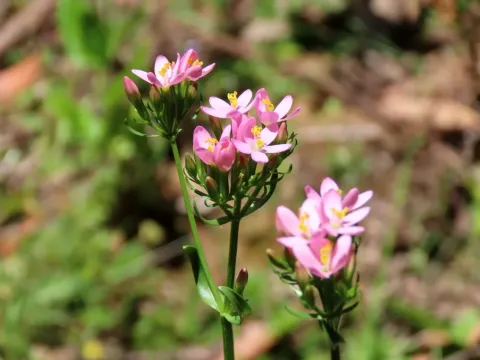
Centaurium
Centaurium
The seeds of Centaurium are extremely small, which requires precise sowing techniques. In agricultural settings, seeds are sown superficially and are not buried deep, as they require light to germinate effectively.
What the section contains
 Ascherson's centaury
Centaurium aschersonianum
Ascherson's centaury
Centaurium aschersonianum
 Centaurium favargeri
Centaurium favargeri
Centaurium favargeri
 Centaurium littorale
Centaurium littorale
Centaurium littorale
 Centaurium pulchellum
Centaurium pulchellum
Centaurium pulchellum
 Centaurium quitense
Centaurium quitense
Centaurium quitense
 Centaurium spicatum
Centaurium spicatum
Centaurium spicatum
 Common centaury
Centaurium centaurioides
Common centaury
Centaurium centaurioides
 Perennial centaury
Centaurium scilloides
Roxburgh's centaury
Centaurium roxburghii
Perennial centaury
Centaurium scilloides
Roxburgh's centaury
Centaurium roxburghii
 Sea centaury
Centaurium maritimum
Sea centaury
Centaurium maritimum
Centaurium
The optimal time for sowing is spring, as soon as the soil warms up, or alternatively, late autumn sowing for natural stratification. Seedlings emerge slowly and require consistent moisture levels throughout the initial growth phase.
For commercial cultivation, it is recommended to maintain a row spacing of 30–40 centimeters to facilitate maintenance and weed control. Sowing density should be moderate to ensure that individual plants have enough space to develop without excessive competition.
It is vital to use high-quality seed material with high germination rates. Sowing should be carried out in a clean, weed-free soil bed to give the young seedlings the best start possible.
After uniform emergence, thinning is performed, maintaining a distance of 10–15 centimeters between plants to allow for robust root system and aerial mass development.
Centaurium belongs to the Gentianaceae family and is a sun-loving species. For successful growth, open, well-lit areas are required, as shading leads to stem elongation and a significant decrease in active chemical components.
The crop prefers moist but not waterlogged soil. Loamy or sandy soils with a neutral or slightly alkaline pH and high organic matter content are considered ideal for cultivation.
In the wild, Centaurium is often found in meadows and along water bodies, which dictates its high water requirements during the growing season. Proper site selection is key to achieving high yields.
The plant does not tolerate soil compaction well and requires regular weeding and hoeing between rows to improve root aeration. Balancing water levels is essential to prevent both drought stress and root rot.
Centaurium has moderate winter hardiness, but in regions with harsh, snowless winters, it may require some protection, especially in its first year, as it is often treated as an annual or biennial crop.
The yield of Centaurium is directly proportional to adherence to agronomic practices and timely harvesting. On average, one hectare can produce 5 to 10 quintals of dried plant mass.
The highest concentration of alkaloids and bitter compounds occurs during the peak flowering period, which is the most critical indicator for harvest readiness. Delaying the harvest leads to a reduction in the overall quality of the raw material.
To increase yield, it is necessary to carry out effective weed control, as Centaurium is particularly vulnerable to competition during the early stages of its development.
Application of organic fertilizers during the leaf rosette formation stage promotes higher vegetative mass, significantly contributing to the total yield at the end of the season.
Harvesting should be conducted in dry weather, which minimizes drying time and helps preserve the maximum amount of active ingredients within the collected herbs.
Fungal diseases, which develop in conditions of high humidity and poor air circulation, pose the greatest threat to Centaurium. Powdery mildew and various forms of rot are the most frequent issues.
Among pests, aphids and leaf beetles can cause substantial damage by feeding on plant sap. This not only affects the plant's health but also significantly reduces the commercial quality of the harvest.
To prevent disease outbreaks, crop rotation and avoiding overly dense plantings are essential. Removing all plant debris from the field immediately after harvest helps reduce the infection pressure for the next season.
In cases of major pest infestations on commercial plantations, biopesticides are preferred over synthetic chemicals, as the plant is intended for medicinal and pharmaceutical use.
Regular field scouting allows for the early detection of disease or pest foci, enabling timely intervention to protect the integrity of the crop.
Harvesting of Centaurium is carried out during the peak flowering stage when the stems are dense and hold the maximum level of valuable medicinal compounds. Manual sickles or specialized harvesters are used for cutting the aerial parts.
Cut material must be sent for drying immediately to prevent overheating and the breakdown of bio-active components. Drying should be done in the shade, under well-ventilated sheds, or in mechanical dryers at temperatures not exceeding 45 degrees Celsius.
It is important to ensure that the stems do not dry too rapidly at high temperatures, as this can result in discoloration and a loss of pharmacological value.
Once drying is complete, the raw material is sorted to remove yellowed leaves, impurities, and any root debris that might have been collected during the cutting process.
The final product should be stored in paper or breathable fabric bags to allow for proper airflow and protection from moisture in storage facilities until further processing.