

Pest · Hemiptera (bugs, aphids, leafhoppers) · affects Winter wheat, Winter barley, Potato
Especially harmful
Aphid
Aphididae
Description
How to identify
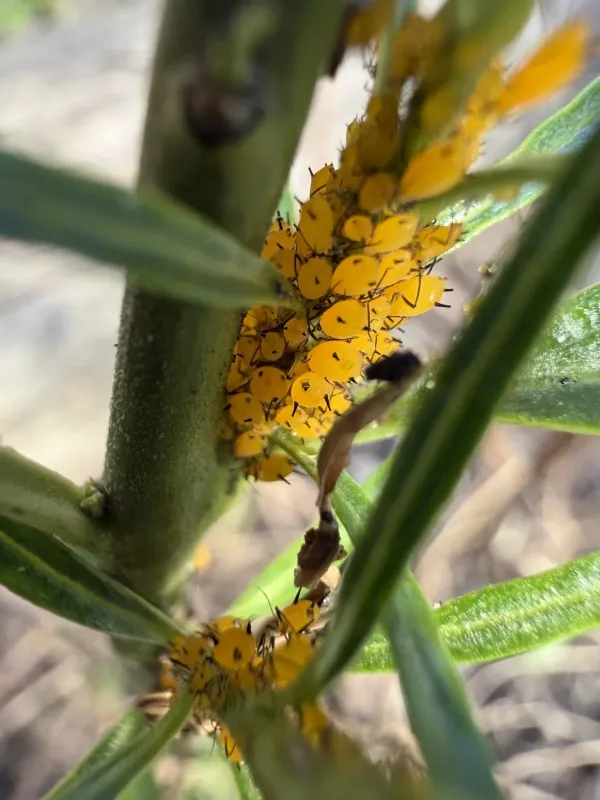
Aphids (family Aphididae) are small, soft-bodied insects known for their ability to reproduce rapidly and form large colonies on host plants.
Most species feature a pear-shaped body and a pair of cornicles on the abdomen, which are diagnostic features for identification.
Their size typically ranges from 0.5 to 6 mm, and their color can vary from translucent green to black or even pink, depending on the host plant.
Aphids possess piercing-sucking mouthparts that allow them to tap into the phloem of the plant to feed on nutrient-rich sap.
They exhibit a complex life cycle involving both asexual (parthenogenetic) and sexual reproduction, allowing for explosive population growth.
What it damages
Aphids are significant pests for a wide range of crops, including fodder beet, winter oilseed rape, and garden cabbage.
They also severely impact industrial and vegetable crops such as industrial hemp, bell peppers, cucumbers, and soybeans.
Strawberries are particularly susceptible, as aphid feeding causes leaf curling, stunting, and can render the fruit unmarketable.
Beyond physical damage, they are notorious vectors of plant viruses, transmitting pathogens while feeding from one plant to another.
The excessive consumption of sap weakens the plant's immune system, making it more susceptible to environmental stress and other diseases.
When it appears
The seasonal activity of aphids generally begins in early spring, when overwintering eggs hatch into stem mothers.
As temperatures rise, multiple generations of wingless aphids are produced, leading to dense colony formations on new plant growth.
When the host plant becomes overcrowded or the quality of sap declines, winged forms are produced to migrate to new host plants.
In autumn, sexual reproduction occurs, leading to the production of winter-hardy eggs that are deposited on perennial hosts.
Environmental factors, such as humidity and temperature, play a crucial role in determining the speed of their reproductive cycle.
Signs of infestation
A classic sign of aphid infestation is the presence of honeydew, a sticky substance excreted by aphids that covers leaves and stems.
Sooty mold, a black fungus, often grows on the honeydew, which inhibits photosynthesis and gives the plant an unhealthy appearance.
Curling, yellowing, or distorted leaves are standard symptoms of sap depletion caused by high-density aphid colonies.
The presence of ants attending to the aphids is a strong indicator of an active infestation, as ants protect aphids to harvest their honeydew.
Visible clusters of insects, often found on the undersides of leaves or along fresh succulent stems, are the most direct evidence of a problem.
Control measures
Integrated Pest Management (IPM) is essential, starting with monitoring fields for the first signs of aphid arrival.
Cultural controls include removing weeds that serve as alternate hosts and managing fertilizer applications to avoid over-fertilizing with nitrogen.
Biological control agents, such as lady beetles, lacewings, and parasitic wasps, are effective at keeping aphid populations at low levels.
Chemical control using systemic insecticides is necessary if the infestation threshold is exceeded to prevent irreversible crop damage.
- Use reflective mulches to deter winged aphids from landing.
- Apply insecticidal soaps or horticultural oils for localized control.
- Maintain a record of previous infestations to plan crop rotation effectively.
In brief
30
Damages crops
Content graph
Damages crops · 30
Content graph
Connections · Aphid
Most often together:
Marketplace
Products · 923
All 923
Insecticides, Acaricides 694
Sorghum 45
Cotton 13
Lettuce 12
Apple 12
Fungicides 11
Plant Growth Regulators 11
Bird Cherry 9
Cherry, Sour Cherry 8
Herbicides, Desiccants 8
Cabbage 8
Biological Products 6


Conquistador 700
Barclay Chemicals Manufacturing Ltd
Herbicides
0
0
·
972
2 offers
19.49 €per 1 l
Buy


Zetavit-Agro
«Нанджин Ессенс Файн-Кемікал Ко. Лтд» (Китай)
Insecticides
0
0
·
897
2 offers
28.6 €per 1 l
Buy


Kordon
Три Дельта Компані Інтернешнл, Гонконг, Китай.
Insecticides
0
0
·
668
1 offer
0.89 €per 1 l
Buy


ALPHA- AMIPRID R.P.
Ф.Меатон Лімітед, Лондон, Великобританія.
Insecticides
0
0
·
161
3 offers
10.77 €per 1 l
Buy

Trayzer, TN
Hailir Pesticides and Chemicals Group Co., Ltd, Shandong, КНР
Insecticides
0
0
·
159
6 offers
1.95 €per 1 l
Buy


Newstar EC, (zeta-cypermethrin, 100 g/l)
Санрайз Кемікалз Ко. Лтд., Шанхай, Китай
Insecticides
0
0
·
151
1 offer
48.3 €per 1 l
Buy

Alphaplan
Аріста ЛайфСайенс С.А.С., Ногер, Франція
Insecticides
0
0
·
125
1 offer
1 534 €per pack
Buy


Alpha-Amid
«Юнісіті Ентерпрайсіс Л.П.», Единбург, Великобританія
Insecticides
0
0
·
95
4 offers
10.77 €per 1 l
Buy

Antikhrushch
ТОВ «Фабрика агрохімікатів», Черкаси, Україна
Insecticides
0
0
·
94
86 offers
2.87 €per 1 l
Buy


Nurel D
Доу АгроСайенсіс, Кінг’з-Лінн, Великобританія
Insecticides
0
0
·
82
7 offers
6.14 €per 1 l
Buy


Ruby K.E.
Sharda Worldwide Exports Pvt Ltd, Sharda World
Insecticides
0
0
·
77
1 offer
10.53 €per 1 l
Buy
Biology
Taxonomy
- Latin name
- Aphididae
- Order
- Hemiptera (bugs, aphids, leafhoppers)
- Family
- Aphididae
- EPPO code
- 1APHIF
Community
Discussion
No discussions yet — be the first.