


SKU #4211
·
409 views
Hungarian Pulkovskaya
Plum
User rating
0 votes0% positive reviews
No ratings yet — be the first.
Type of Sort
Home Drain
Store offers · 2 from 2 stores
Prices are updated on loadLoading offers…
Available at: Лучший Сад · Наследие
Aggregator catalog: prices are collected automatically from store websites, normalized by AI and converted at the current exchange rate. Before ordering, confirm the price and availability on the store's website. This block is not indexed by search engines — the data is loaded after the page opens.
About product

Winter, Pokrovka, Pulkovskaya, Winter Red
A folk selection variety, originating from the villages of Pulkovskoye, Antropshino, and Pokrovka in Leningrad Oblast. Introduced into the State Register in 1959.
A strongly vigorous tree (up to 4-5 m tall), with a sparse, wide-oval or broom-like crown. Branches are reddish-brown, twig-like, curved, fairly long, departing at an angle of 40-45°. Bark…
Type of Sort
Home Drain
Description
Winter, Pokrovka, Pulkovskaya, Winter Red
A folk selection variety, originating from the villages of Pulkovskoye, Antropshino, and Pokrovka in Leningrad Oblast. Introduced into the State Register in 1959.
A strongly vigorous tree (up to 4-5 m tall), with a sparse, wide-oval or broom-like crown. Branches are reddish-brown, twig-like, curved, fairly long, departing at an angle of 40-45°. Bark on the trunk is gray-brown, rough, matte. One-year shoots are brown in winter and reddish-brown in summer. Leaf blade is oval or inversely egg-shaped, bluntly pointed with a curved or rounded base, medium-sized (7 x 4.5 cm), green or light-green, slightly concave along the central vein or its margins slightly raised, thin, glossy, loose in texture, with a weak downy pubescence underneath. Leaf margin is mid- to 1-2-toothed. Petiole 1.5 cm long, medium thickness, weakly colored with anthocyanin. Stipules 1-2, small, sessile, yellow-green. Stipules appear only on growth shoots, small, dissected, pale green. Flowers are moderately open (type 2). Corolla is flat, up to 25-30 mm in diameter. Petals are broadly oval, white, medium-sized (13 x 8 mm). Stamens 28-35. Stigma is positioned higher than the anthers or at the same level. Style is without pubescence. Calyx is bell-shaped, pubescent. Pedicel 12-18 mm long, without pubescence. Flowering and fruiting are concentrated on two-year and multi-year wood (type 2).
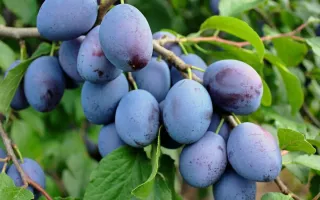
Fruits are oval, unequal-sided, weighing 20-25 g (35 x 30 x 30 mm), dark red, with dark subcutaneous dots and a fairly strong waxy bloom. Apex and base are oval. Pit is of medium depth. Ventral suture is moderately developed. Flesh is yellowish, finely textured, fairly juicy, tart-sweet, with satisfactory flavor. Fruit stalk 12-18 mm long (rarely 20-22 mm). Stone is oval, medium-large, easily separates from the flesh. Fruits contain up to 14.5% dry matter, 7.4-9.5% sugars (monosaccharides — 5%, sucrose — 2.5-3.3%), 1.1-1.9% acids, 9.9-15.3 mg/100g ascorbic acid. Fruits are consumed fresh and used for making jams, compotes, and jellies.
Flowers in late May to early June. Fruits ripen in September, not simultaneously, but do not drop. Grafted plants begin fruiting in 3-4 years after planting in the garden, while suckers begin fruiting in 6-7 years. Lifespan up to 20-25 years. Self-fertile (self-pollination sets 10-20% of fruits). With pollinators (Red Early, Hungarian Moscow, Leningrad Blue, and others), yields are higher than with self-pollination. Yield 15-20 kg per tree, regular.
Cold hardiness is moderate; in severe winters, trees suffer damage up to 3-4 points. Aphid damage is weak, with punctate spotting up to 2 points. After a wet spring, affected by "cushion" disease. Under waterlogged conditions, fruits crack and are attacked by fruit rot.
Variety is well propagated by root suckers. Plants grow better and fruit more on moisture-retentive, loamy, well-fertilized soils, poorly tolerate shallow groundwater and heavy clay subsoil.
Advantages of the variety: moderate cold hardiness, fairly good adaptability, self-fertility, good yield, large fruits, non-drop of fruits at maturity, easy stone separation from flesh, relatively long plant lifespan, ability to propagate by root suckers, relative resistance to diseases and pests.
Disadvantages of the variety: uneven fruit ripening, lower fruit quality, high soil requirements, fruit cracking in wet years.
Video · 1 video
Suggest a video →Crop & resistance
Crop
Disease resistance
Pest resistance
Specifications
| Type of Sort | |
|---|---|
| Catalog | Catalog → Plum |
Not yet комментариев. Be the first!
Alternatives
Plum saplings · similar varieties



See also
Often considered together with this variety


Recently viewed
Products you’ve viewed on this site
Reviews · 0