



SKU #4070
·
397 views
Early Marusich
Apricot
User rating
0 votes0% positive reviews
No ratings yet — be the first.
Assignment
For Fresh Consumption
Ripening Period
25-28
Flavor
Sour-sweet
Core
Easily removable
Store offers · 1 from 1 stores
Prices are updated on loadLoading offers…
Available at: Agromir
Aggregator catalog: prices are collected automatically from store websites, normalized by AI and converted at the current exchange rate. Before ordering, confirm the price and availability on the store's website. This block is not indexed by search engines — the data is loaded after the page opens.
About product

The variety was obtained by E.F. Koroleva, G.T. Kazymin, and V.A. Marusich at DalNIISKh through interspecific crosses (Laureate x Khabarovsk). The variety is undergoing state testing in 1997 for the Far East region. Medium-sized tree with a moderately dense, spreading crown. Bark on the trunk and main branches is flaking and gray. Shoots are medium-sized and gray. Buds are medium-sized, rounded-o…
Assignment
For Fresh Consumption
Ripening Period
25-28
Flavor
Sour-sweet
Core
Easily removable
Description
The variety was obtained by E.F. Koroleva, G.T. Kazymin, and V.A. Marusich at DalNIISKh through interspecific crosses (Laureate x Khabarovsk). The variety is undergoing state testing in 1997 for the Far East region.
Medium-sized tree with a moderately dense, spreading crown. Bark on the trunk and main branches is flaking and gray. Shoots are medium-sized and gray. Buds are medium-sized, rounded-oval, and slightly lag behind the shoots. The variety is characterized by strong foliage. Leaves are medium-sized, dark green, and long-pointed. Leaf blade is flat. Leaf margin is finely serrated. Petiole is medium-sized. Leaves remain healthy and intact until the end of the vegetative period, turning yellow-orange in autumn. Fruit placement is predominantly on cluster branches. Predominantly solitary flower buds. Flowers are medium-sized and white. Petal shape is rounded. Petal closeness is medium. Calyx is narrow-bowl-shaped. Pedicel is very short. The variety is self-sterile (stigma is positioned higher than the anther). Best pollinators: varieties 'Khabarovsk' and 'Amur'.
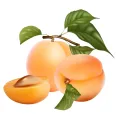
Fruits are one-dimensional, sufficiently large for local cultivars, average weight 28 g, maximum 32 g. Fruit height is 31 mm, diameter in two planes 32-28 mm. Shape is rounded and blunt. Fruit apex is rounded. Pit is wide and shallow. Ventral suture is medium-depth and prominent. Pedicel is short, easily separates from the branch and is loosely attached to the stone. Main fruit color is yellow, with a reddish covering, no lenticels. Flesh is medium-juicy, yellow, and sweet-tart flavored. Fruits contain 6.5% sugars, 1.6% acids, 11.3% dry matter, and 7.3% vitamin C. Fruits are suitable for fresh consumption and technical processing. Fresh fruit taste rating is 4.5 points. Fruit transportability is medium. Stone is completely free, medium weight 1.4 g, rounded in shape, blunt, surface with pits.
Flowering period from May 10 to 15. According to fruit ripening time, the variety belongs to the early group — ripening occurs at the end of July (July 25-28). Trees enter fruiting phase in the third year after grafting, depending on seedling quality. Grafted trees on strong rootstocks flower in the second year after planting. The variety is capable of annual fruiting. Yield over the years: 1991 — 7.5 kg/tree, 1992 — 26.8 kg, 1993 — 18.5 kg, 1994 — 30.2 kg, 1995 — 12.6 kg.
The variety exhibits high winter hardiness. During testing, only slight frost damage to one-year-old shoots was observed (up to >0.5 points). Trees are relatively resistant to Clasterosporium, and to pests such as aphids. Due to early fruit ripening, fruits are less damaged by fruitworms.
Advantages of the variety: high winter hardiness of trees, early ripening, and excellent fruit flavor.
Disadvantages of the variety: fruits are poorly transportable, and in wet years the stone detaches insufficiently well.
Video · 1 video
Suggest a video →Crop & resistance
Crop
Disease resistance
Pest resistance
Specifications hover over for a hint about the specification
| Assignment | |
|---|---|
|
Ripening Period
Ripening Period
It takes 70-100 days until pepper reaches flowering stage, 130-160 days until technical fruit ripeness, and 135-180 days until physiological ripeness. |
25-28 |
| Flavor | |
| Core | |
| Fetal Size | 2.8-3.2 |
|
Yield
Yield
Overall bulb harvest per unit area. Depends on both onion variety characteristics and agronomic practices, fertilizers, and irrigation. Under optimal growing conditions, an onion yield of 100 tons per hectare and above is not considered record-breaking. |
7.5-30.2 |
| Frost Resistance | |
| Self-fertility | |
| Disease Resistance | |
| Transportability | |
| Features | |
| Catalog | Catalog → Apricot |
Not yet комментариев. Be the first!
Alternatives
Apricot saplings · similar varieties


See also
Often considered together with this variety



Recently viewed
Products you’ve viewed on this site
Reviews · 0