
Bacterial wilt
Erwinia chrysanthemi
Description
Symptoms
The first symptoms typically appear as a sudden loss of turgor in leaves and shoots, often starting during the heat of the day and appearing as wilting.
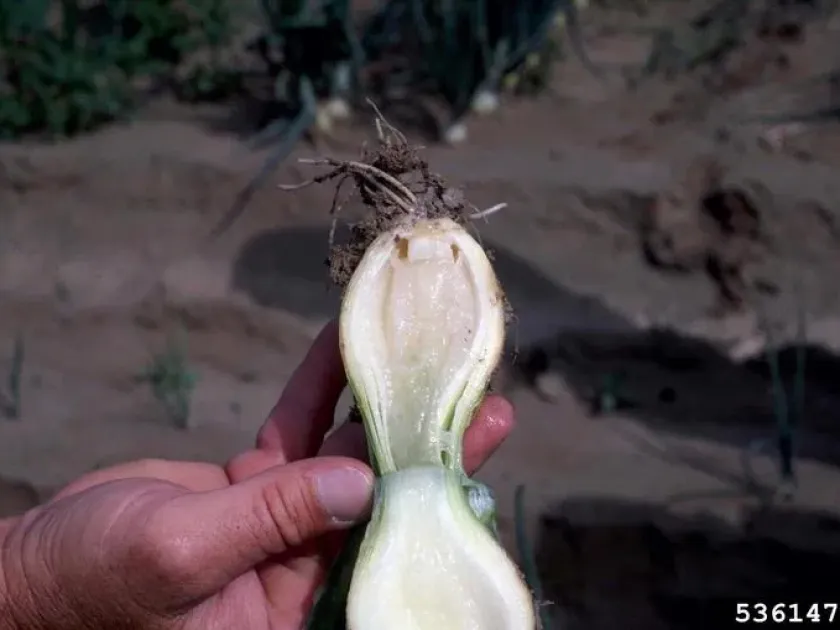
As the infection progresses, affected tissues become soft, mushy, and may exhibit water-soaked lesions that often emit a foul odor due to secondary decay.
A cross-section of the stem or root reveals characteristic browning and blackening of the vascular bundles, indicating that the bacteria have colonized the plant's transport system.
In humid conditions, small droplets of bacterial ooze (exudate) may appear on the surface of stems and leaf petioles, which serve as inoculum for further spreading.
In advanced stages, the entire plant may collapse completely, turn necrotic, and die within a very short period of time, leading to significant yield losses.
Pathogen
The causative agent of this disease is the gram-negative bacterium Dickeya chrysanthemi, formerly classified as Erwinia chrysanthemi, which belongs to the Pectobacteriaceae family.
This pathogen is known for its ability to produce pectinolytic enzymes, which degrade the plant cell walls and middle lamella, leading to tissue maceration and collapse.
The bacterium is a soil-borne and seed-borne pathogen, capable of surviving in infected plant debris and persistent in the vascular tissues of various host plants.
Transmission occurs through infested irrigation water, rain splash, contaminated tools, and infected propagation material like cuttings or seeds.
It affects a broad range of agricultural crops, including celery, oats, hemp, coffee, hazelnuts, soybeans, and cotton.
Conditions for development
Warm temperatures, particularly between 25°C and 30°C (77°F–86°F), provide an optimal environment for the rapid multiplication of Erwinia chrysanthemi.
High humidity and moisture levels in both the air and soil are critical factors that promote the development of bacterial wilt in greenhouses and field crops.
Wounds caused by insect feeding, hail damage, or improper handling during cultivation allow the bacteria to enter the plant tissues easily.
Poor ventilation in enclosed growing spaces leads to high relative humidity, which is one of the most favorable conditions for the disease to spread rapidly.
Plants under stress from nutrient deficiencies or irregular watering schedules are much more susceptible to the infection than healthy, vigorous plants.
Why it matters
Bacterial wilt is highly destructive because it rapidly colonizes the plant's vascular system, often rendering chemical control treatments ineffective once symptoms appear.
It causes significant economic damage to the agricultural sector, especially in seed production and high-value greenhouse crops, where entire batches may be lost.
The disease reduces the quality of harvested products, making them unsuitable for long-term storage or processing due to their tendency to rot quickly.
In woody perennial crops, such as hazelnut or coffee, the disease can lead to the decline of entire branches or the death of the tree, requiring long-term recovery efforts.
Once established in a field or nursery, the pathogen is extremely difficult to eradicate, necessitating strict quarantine and sanitation protocols.
Protection
Prevention starts with using pathogen-free, certified seeds and cuttings to ensure that the disease is not introduced into the cultivation area.
Implementing strict crop rotation schedules, avoiding planting susceptible species in the same soil for several years, is essential to break the life cycle of the bacteria.
Regular sanitation of agricultural tools and machinery is crucial to prevent the mechanical transfer of the bacterium from infected to healthy plants.
- Promptly rogue and destroy any symptomatic plants to limit the spread of the pathogen.
- Manage insect pests that cause wounding and act as vectors for bacterial movement.
- Ensure proper drainage and avoid overhead irrigation to keep the canopy dry.
Applying biological control agents and maintaining optimal plant nutrition can bolster the plant's natural defenses against bacterial entry and colonization.
Pathogens and affected parts
Affects crops · 19
Discussion
No discussions yet — be the first.