
Coffea canephora
Coffea canephora Pierre ex A. Froehner
Description
Sowing dates
Propagation of Coffea canephora, commonly known as Robusta, is typically achieved through seeds in well-drained nursery beds or via vegetative cutting methods.
Seeds are sown in prepared soil, and germination usually occurs within six to eight weeks, followed by transplanting into individual containers once the first leaves emerge.
Vegetative propagation is preferred for industrial plantations to ensure genetic uniformity and high yield characteristics across the crop population.
The optimal time for transplanting young trees into the permanent field is the start of the rainy season to ensure sufficient moisture for root establishment.
Planting density is generally maintained between 2,500 and 3,500 trees per hectare, depending on the irrigation system and planned mechanical harvesting methods.
Growing requirements
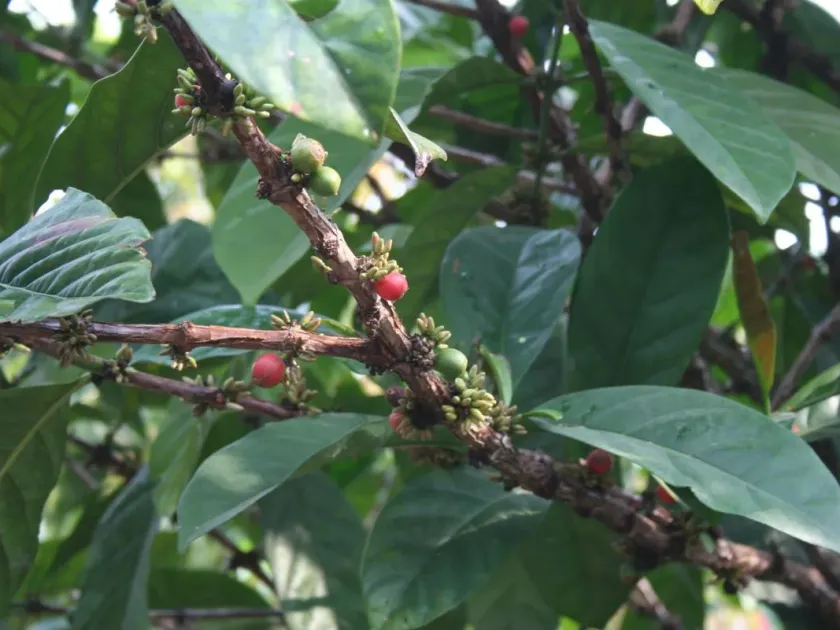
Coffea canephora is an evergreen shrub of the Rubiaceae family that is significantly more robust and resilient than the Coffea arabica species.
The crop thrives in tropical lowland climates, requiring temperatures between 22°C and 30°C and consistent annual rainfall of 1,500–2,000 mm.
Soils should be deep, fertile, and well-drained, with a slightly acidic to neutral pH, ensuring the roots remain free from waterlogging and have proper aeration.
While tolerant to direct sunlight, young plants often benefit from shade trees which help regulate the microclimate and protect against extreme heat and dehydration.
Its high adaptability allows it to be cultivated in diverse geographic regions, making it a key economic crop for tropical countries around the globe.
Yield
Coffea canephora is prized for its high yield capacity, which often exceeds that of Arabica, making it a staple for the commercial coffee industry.
Plants start producing fruit within two to three years of transplanting, providing a relatively fast return on investment for farmers.
Commercial yields typically range from 1.5 to 3 metric tons of processed beans per hectare, influenced by fertilizer application and pruning techniques.
The harvest season is extended as cherries mature asynchronously on the branch, necessitating multiple picking rounds to ensure the fruit is fully ripe.
The resulting crop is extensively used for instant coffee production and in espresso blends due to its intense flavor and high caffeine content.
Main diseases and pests
Although naturally resistant to many pests, Coffea canephora is still susceptible to several pathogens that require proactive integrated pest management.
- Coffee Leaf Rust (Hemileia vastatrix) — a major fungal disease affecting the foliage.
- Root-knot nematodes — microscopic worms that damage root systems and weaken plants.
- Anthracnose and Cercospora leaf spot — common fungal diseases causing necrotic lesions.
- Fusarium wilt and Gray mold — typically occur in environments with high humidity.
- Rhizoctonia — a soil-borne fungus that poses a risk in crowded nursery environments.
Harvesting
Harvesting is performed either manually to select only perfectly ripe red cherries or mechanically to reduce labor costs in large-scale operations.
Post-harvest processing involves either the dry method, where cherries are sun-dried, or the wet method, where the pulp is removed before drying.
Drying is a critical phase where beans must reach a moisture content of roughly 10–12% to prevent microbial growth and ensure shelf stability during transport.
Quality control during drying is essential to avoid "fermented" or "musty" taints that can significantly lower the market value of the batch.
Once dried, the coffee undergoes hulling, cleaning, and grading based on bean size and density before being packaged for domestic use or export.