
Xanthomonas juglandis
Xanthomonas juglandis
Description
How to identify
Xanthomonas juglandis (formerly known as Xanthomonas juglandis or Xanthomonas arboricola pv. juglandis) is a Gram-negative, rod-shaped bacterium belonging to the Xanthomonadaceae family. It is a highly specialized plant pathogen that primarily targets species within the Juglandaceae family.
The pathogen overwinters in dormant buds, catkins, infected fruit mummies, and tree bark. In spring, the bacteria become active and are disseminated by rain splashes, irrigation water, and insect pollinators to healthy plant tissues.
The microorganism invades plant tissues through natural openings such as stomata and lenticels or through mechanical wounds. Once inside, the bacteria multiply rapidly in the intercellular spaces, secreting enzymes that degrade cell walls.
The bacteria can remain viable in fallen leaves and dry fruits for up to two years, serving as a persistent inoculum source in orchards. Soil survival is less significant, making canopy sanitation a priority for management.
Laboratory identification involves isolating the culture on selective media, where characteristic yellow colonies emerge. This pigmentation is due to the production of xanthomonadin, a hallmark of the genus.
What it damages
The primary host for this pathogen is the English walnut (Juglans regia). The infection affects all aerial parts of the tree, including leaves, fruit, blossoms, current-year shoots, and buds.
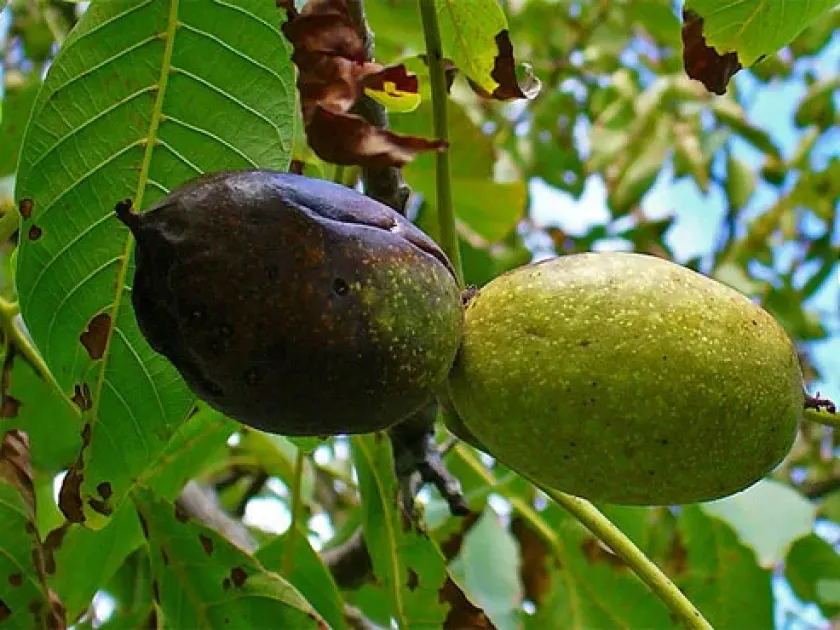
Early-season fruit infection is the most devastating. If the pathogen enters young nuts, they turn black, shrivel, and drop prematurely, leading to yield losses of up to 70–90% in severe outbreak years.
Leaves exhibit necrotic spots, which reduce the total photosynthetic area of the tree and weaken its overall vigor and resistance against winter stress.
Current-season shoots infected with Xanthomonas become deformed and develop lesions, which may lead to the dieback of terminal branches and impaired tree development.
In mature trees, bark lesions can form localized necroses, which serve as entry points for secondary fungal pathogens and wood-rotting organisms.
When it appears
Disease development peaks during wet and warm spring periods, coinciding with active growth and the flowering stage. The bacterium is highly dependent on the presence of free moisture.
High humidity and frequent rainfall during pollination facilitate the movement of bacteria from male catkins to female blossoms, often causing significant blossom blight and loss of potential fruit set.
Summer disease progression continues during prolonged rainy spells when water splashes spread the inoculum throughout the canopy. Conversely, hot and dry weather conditions significantly inhibit the spread.
In the autumn, as temperatures drop and moisture increases, the pathogen migrates from foliage back into buds, where it remains protected through the dormant season.
The overall intensity of the epidemic is directly correlated with weather patterns, with the most destructive outbreaks occurring when high humidity coincides with temperatures between 20–28°C.
Signs of infestation
Leaves display small, angular, dark spots, often surrounded by a yellowish halo. As the infection progresses, these spots coalesce, causing the leaf to turn black and drop early.
Fruits develop small black spots with a greasy, water-soaked appearance. Deep infections penetrate to the nut kernel, causing it to rot, turn black, and emit a foul odor.
Young shoots exhibit elongated, sunken dark lesions, which often cause the stems to twist or bend. Gum exudation is frequently observed at the lesion sites.
Inflorescences (catkins) show signs of blackening and necrosis, which prevents proper pollen shed and inhibits the fertilization of female flowers.
Under conditions of extremely high humidity, a yellowish bacterial ooze may be visible on the surface of lesions, which eventually dries into a shiny, varnish-like film.
Control measures
Cultural management is the primary defense strategy: timely pruning and removal of infected twigs, combined with the collection and destruction of fallen leaves and mummified fruits, are essential.
Selecting and planting resistant walnut cultivars is the most reliable long-term solution for minimizing losses, as chemical control options are often limited and difficult to time.
Preventive applications of copper-based bactericides (such as Bordeaux mixture or copper oxychloride) during dormancy and early leaf emergence help manage the initial inoculum levels.
- Spraying before bud break.
- Applying repeat treatments during the flowering window if rainy weather is forecasted.
- Using antibiotics in regions where such treatments are approved by agricultural authorities.
- Ensuring proper orchard spacing to improve air circulation and reduce canopy humidity.
Rigorous sanitation of pruning tools using appropriate disinfectants is critical after working on infected trees to prevent mechanical transmission throughout the orchard.
Causes diseases · 1
Discussion
No discussions yet — be the first.