
Description
Symptoms
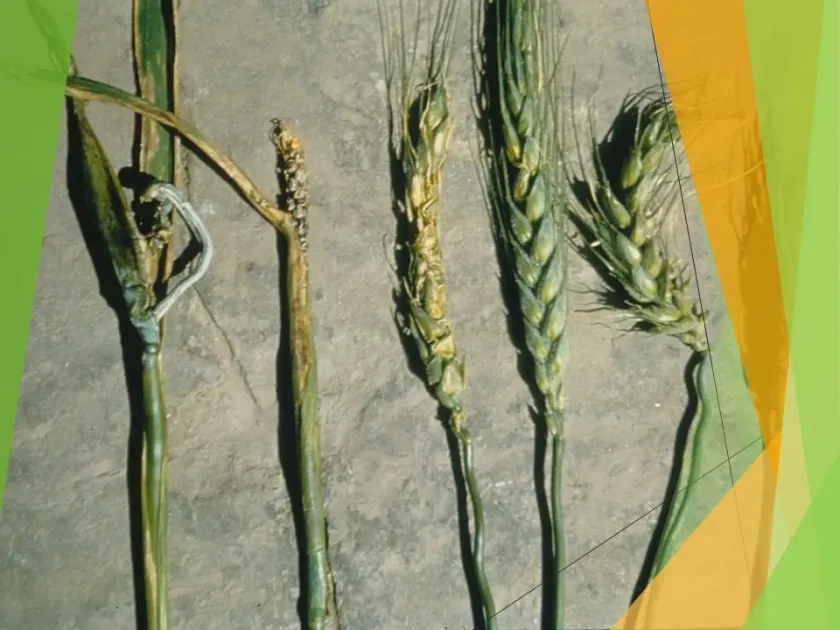
The main external symptom of the disease is the deformation of the wheat ear and stem. Infected ears are often distorted, their glumes grow abnormally and turn greenish, while the grains are replaced by yellow galls filled with bacterial mass.
During the flowering stage, a sticky bacterial exudate can be observed on the surface of the infected ears, which dries over time to form a yellow film. This phenomenon is often referred to as "wheat glue" or "yellow slime."
Infected plants show significantly stunted growth and often lodge, which interferes with the proper development of reproductive organs. Such fields appear sparse, with characteristic patches of underdeveloped plants.
Dissection of the ears reveals the absence of normal kernels; instead, larvae of the nematode Anguina tritici, which serve as vectors for the bacterial infection, are found within the glumes.
In the later stages of the disease, the infected parts of the plant turn brown or black due to colonization by secondary fungal pathogens following tissue death.
Pathogen
The causative agent of the disease is the bacterium Rathayibacter tritici, which develops in close symbiosis with the wheat nematode Anguina tritici. The bacterium is unable to penetrate the healthy plant on its own without the help of the vector.
The nematode acts as the primary invasive agent, damaging plant tissues and creating "entry points" for pathogenic bacteria residing in the soil or within the galls.
The infection process begins when nematode larvae enter the seedlings of winter wheat. Along with the larvae, the bacterial microflora penetrates the plant tissues and begins to multiply actively in the intercellular spaces.
The bacterium produces specific toxins that cause hypertrophy and deformation of the ear tissues, preventing the formation of normal seeds and promoting the development of galls.
The life cycle of the pathogen is inextricably linked to the life cycle of the nematode, so disease control requires an integrated approach targeting both the bacterial and nematode components.
Conditions for development
Favorable conditions for the development of the disease include cool and moist weather during the germination and tillering stages of winter wheat, which facilitates nematode activity.
Mass spread of the infection is observed in fields where crop rotation is neglected, especially when wheat is grown consecutively for several years on the same plot.
The infection persists in the soil and plant debris in the form of dried nematode galls, inside which bacteria can remain viable for several years until favorable conditions return.
High humidity during the heading stage contributes to the increase of bacterial exudates and more intensive infection of neighboring plants in the field.
Contamination also actively occurs through the use of poor-quality seed material contaminated with nematode galls, which are similar in size and weight to wheat grains.
Why it matters
The disease poses a serious threat to winter wheat yields, causing both quantitative and qualitative grain losses, sometimes leading to total crop failure in specific areas.
Infected plants do not produce marketable grain, as the entire ear is transformed into a collection of galls filled with bacterial mass and nematodes.
A reduction in crop productivity makes further management of the affected areas during the current growing season economically unjustifiable.
The presence of galls in the harvested crop severely lowers its grade and marketability, rendering the grain unsuitable for the food industry due to toxicity and high bacterial counts.
Additional damage lies in the accumulation of infectious potential in the soil, preventing the cultivation of susceptible crops in that field for years without thorough disinfection measures.
Protection
The primary control measure is strict adherence to crop rotation by incorporating crops that are not hosts for the wheat nematode, which breaks the parasite's life cycle.
Thorough cleaning of seed material using modern pneumatic gravity separators allows for the effective removal of nematode galls, which differ in density from healthy grains.
The use of resistant or tolerant winter wheat varieties significantly reduces the risk of crop infection when the pathogen is present in the soil layer.
Deep autumn plowing with inversion of the soil furrow helps bury the galls at a depth that prevents nematodes from reaching the surface and infecting crop seedlings.
- Use of certified seeds free from galls.
- Adherence to optimal sowing dates.
- Elimination of volunteer wheat in fields after harvest.
- Maintaining spatial isolation between fields.
Pathogens and affected parts
Affects crops · 1
Discussion
No discussions yet — be the first.