
Bacterial blight of rice
Xanthomonas oryzae
Description
Symptoms
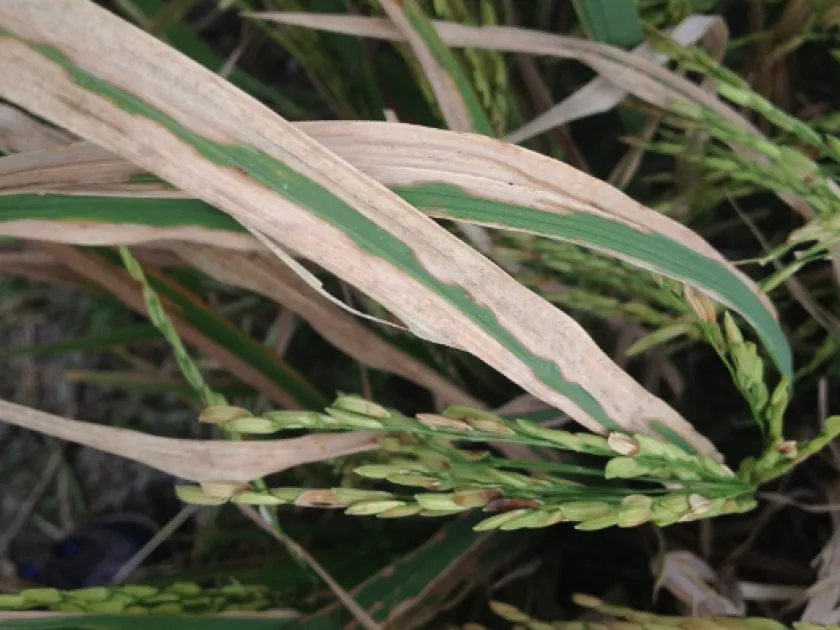
The initial signs typically appear as water-soaked, yellowish stripes along the leaf margins, which eventually widen and spread towards the leaf base.
Under humid conditions, small droplets of bacterial ooze can often be observed on the surface of the lesions; these droplets dry into hard, yellowish crusts.
As the disease progresses, the leaves turn yellow to grayish-white, and the entire leaf blade may eventually wither and die prematurely.
In cases of systemic infection, especially in young seedlings, the plants may undergo a rapid wilting process known as the 'kresek' phase, leading to plant death.
Cross-sectioning of the infected culm often reveals a turbid bacterial exudate oozing from the vascular bundles, confirming the presence of the pathogen.
Pathogen
Bacterial blight of rice is caused by the Gram-negative, rod-shaped bacterium Xanthomonas oryzae pv. oryzae, which primarily invades the vascular system of the host plant.
The pathogen enters the plant through hydathodes at the leaf margins, stomata, or wounds caused by insect feeding or mechanical operations in the field.
Once inside, the bacteria colonize the xylem vessels, multiplying rapidly and producing extracellular polysaccharides that obstruct the flow of water and nutrients.
The bacteria can survive in infected rice stubble, volunteer rice plants, and several weed species in the Poaceae family during the off-season.
This pathogen is considered a significant threat to global rice production due to its high transmission efficiency and ability to cause severe epidemics.
Conditions for development
The development of the disease is highly favored by warm temperatures, typically between 25 and 30 degrees Celsius, and high relative humidity levels.
Heavy rainfall, strong winds, and typhoons facilitate the splash dispersal of the bacteria from plant to plant and create wounds that serve as infection courts.
The application of high doses of nitrogen fertilizer promotes lush vegetative growth, making the rice plants significantly more susceptible to bacterial infection.
Poor water management in paddy fields, including stagnant water or deep-water stress, contributes to the rapid spread of the bacteria within a field.
High planting density restricts airflow and maintains a constant high-humidity microclimate within the canopy, which accelerates the disease cycle.
Why it matters
Bacterial blight is among the most devastating diseases of rice worldwide, with the potential to cause yield losses exceeding 50% in susceptible varieties.
The destruction of leaves leads to reduced photosynthetic capacity, which directly results in poor grain filling and a lower total grain weight at harvest.
Affected plants produce inferior quality grains that are often chalky or shriveled, reducing the milling recovery and market value of the harvested rice.
Early-season infections can lead to total crop failure, necessitating replanting and causing substantial economic loss for rice farmers.
The disease also weakens the plant's structural integrity, making it more prone to secondary infections and lodging under adverse weather conditions.
Protection
The most sustainable and effective management strategy is the widespread cultivation of resistant or moderately resistant rice varieties.
Farmers should prioritize the use of high-quality, pathogen-free certified seeds to prevent the introduction of the disease into clean fields.
Balanced fertilization practices, emphasizing the moderate use of nitrogen combined with sufficient potassium, help improve plant defense mechanisms.
Field sanitation measures, such as the destruction of infected stubble and control of grassy weeds, are essential to break the survival cycle of the pathogen.
- Implementing proper drainage to manage water levels effectively.
- Avoiding mechanical damage to rice leaves during field maintenance.
- Applying copper-based bactericides if early symptoms are detected.
- Maintaining optimal plant spacing to promote adequate ventilation.
Discussion
No discussions yet — be the first.