
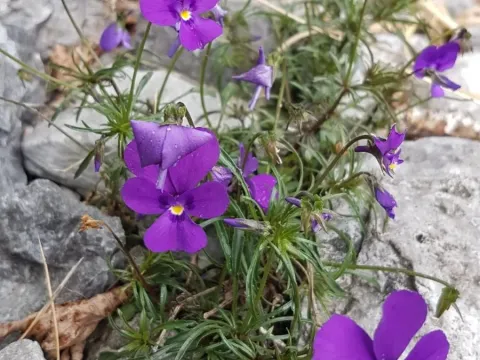
Duby's violet
Viola dubyana
Duby's violet (Viola dubyana) is a perennial herbaceous plant belonging to the Violaceae family. It is a specialized alpine species endemic to the mountainous regions of Southeastern Alps.
What the section contains
Duby's violet
The plant naturally thrives in rocky environments, limestone scree, and alpine meadows where drainage is excellent and nutrient availability is moderate. It is evolved to survive in extreme altitude conditions.
For successful cultivation, Duby's violet requires a gritty, well-draining soil medium, ideally with a slightly alkaline pH. It is crucial to replicate its natural environment by providing a substrate that does not retain excess water.
The climatic preferences include cool summers and cold winters. It struggles significantly in low-altitude, high-heat environments, which often causes the plants to succumb to heat stress and physiological collapse.
Botanically, the plant is characterized by a low-growth habit, small rosette leaves, and distinct floral structures. These features make it highly sought after by rock garden enthusiasts and collectors of rare alpine vegetation.
The primary threat to Duby's violet in cultivation is root rot, triggered by poor drainage or excessive soil moisture levels during dormant or growing periods.
Fungal diseases, including powdery mildew, represent a significant threat when air circulation around the plants is restricted or humidity levels are excessively high.
Pests such as spider mites and aphids are common challenges that can rapidly degrade the plant's health, leading to yellowing of leaves and loss of vigor.
Gastropods like slugs and snails are highly detrimental, as they often graze on the tender alpine foliage, leaving the plant susceptible to secondary infections.
Competition from more aggressive plant species in garden settings can quickly overwhelm the fragile Duby's violet, making manual weeding and space management vital for plant survival.