
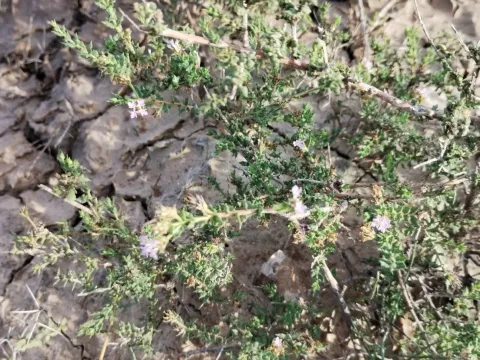
Lippia salsa
Lippia salsa
Lippia salsa belongs to the Verbenaceae family and is recognized as a persistent, salt-tolerant perennial herb. Its ability to thrive in challenging environments makes it a focal point for agricultural research in arid and saline regions.
What the section contains
Lippia salsa
The optimal sowing time begins in early spring, once soil temperatures consistently exceed 12-15 degrees Celsius. This timing ensures that seedlings have sufficient warmth to establish their root systems before the onset of extreme summer heat.
Due to the small size of the seeds, they must be sown at a shallow depth, usually just under the surface, followed by light rolling to improve soil-to-seed contact and moisture retention.
Using nursery-grown transplants can significantly increase survival rates in saline soils, as it bypasses the most sensitive early germination stage in harsh open-field conditions.
The density of sowing should be calculated based on the salinity level of the field; higher salinity may require slightly higher seeding rates to compensate for potential lower germination percentages.
Lippia salsa thrives in conditions with high solar radiation and requires minimal shading to reach its full vegetative potential. It is adapted to soils with varying degrees of salinity, showing high resilience to mineralized soil solutions.
Good soil aeration is critical, as stagnant water in saline environments can lead to root degradation. Well-drained soils allow the plant to better regulate its osmotic potential under saline conditions.
Climatic requirements are centered on high temperatures and consistent but controlled irrigation, particularly during the early vegetative phase to establish the crop.
The plant demonstrates a broad tolerance for pH levels, generally favoring neutral to slightly alkaline conditions, which are characteristic of lands prone to natural or secondary salinization.
- Light requirement: High, needs direct sunlight.
- Salinity tolerance: High, effective in salt-affected soils.
- Watering: Moderate, requires consistent moisture during establishment.
The yield of Lippia salsa depends heavily on the level of soil management and the specific salt concentration of the site. In managed environments, it can produce a substantial amount of biomass suitable for fodder.
As a perennial crop, it offers the advantage of multiple cuts per season, maximizing the total biomass output and providing a steady supply of feed for livestock in areas where other forage crops fail.
The biological productivity of Lippia salsa is linked to its adaptation to harsh conditions, allowing it to remain green and productive when traditional forage crops begin to wilt.
Nutrient supplementation, particularly micronutrients, can significantly enhance growth rates on saline soils, translating to higher biomass volume and improved feed quality.
Regular weeding and soil surface management are necessary in the first year of production to minimize competition and ensure that the stand reaches its maximum yield capacity.
The primary threats to Lippia salsa include fungal infections, such as powdery mildew, which can occur if the crop is planted in areas with poor airflow and high humidity during the growing season.
Common pests include sap-sucking insects like aphids and spider mites. These are most active during peak heat and may require monitoring to prevent significant foliage damage.
Root rots are potential risks if the irrigation regime is poorly managed or if the field lacks adequate drainage, leading to waterlogged conditions that weaken the plant's natural defense mechanisms.
Biological control agents are often the preferred method for managing pests in Lippia salsa, as they minimize environmental impact and maintain the quality of the harvested forage.
Effective stand management includes regular monitoring for disease indicators to implement early intervention, which is essential to protect the long-term health of the perennial stand.
The harvesting process should be timed to coincide with the early flowering stage to ensure the highest concentration of protein and minerals within the foliage, which optimizes feed quality.
Standard forage harvesting machinery is effective for this crop, provided the cutting height is calibrated to avoid damaging the crown of the plant, which is vital for regrowth.
Immediate processing, such as ensiling or rapid drying, is necessary to preserve the nutritional value of the biomass, especially in high-temperature environments where degradation can occur rapidly.
In cases where Lippia salsa is utilized for phytoremediation, the harvested biomass must be handled separately and disposed of according to standard protocols for contaminated materials.
The number of cuts per season depends on the length of the growing period and the efficacy of the irrigation schedule, with 2-4 cuts being typical under favorable conditions.