
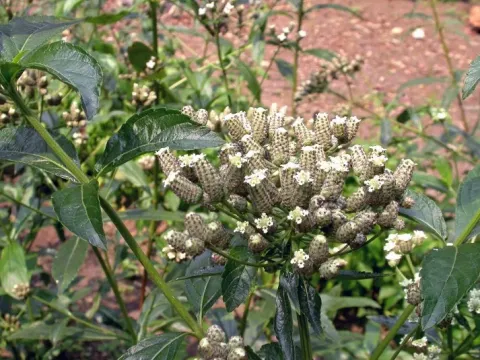
Lippia multiflora
Lippia multiflora
Lippia multiflora is typically propagated through vegetative cuttings, which ensures uniformity in plantations intended for essential oil production. Planting is ideally scheduled at the onset of the rainy season to allow the root systems to establish without the need for intensive irrigation.
What the section contains
Lippia multiflora
For research or breeding purposes, seed propagation is utilized. Seeds are sown in nursery beds with a fine, well-aerated soil medium, keeping them consistently moist until germination, which usually occurs within two to three weeks under warm conditions.
Transplanting seedlings to the main field occurs once they reach a height of approximately 20 centimeters. Careful handling is required to protect the root ball, as the plant needs to acclimatize to the field soil's specific structure and drainage conditions.
Row spacing should be maintained at 60 to 80 centimeters to facilitate mechanical weed control and harvesting. Proper spacing is essential to reduce the competition for nutrients and light among individual shrubs within the plantation.
Post-planting care involves initial mulching to suppress weeds and conserve soil moisture. Young shrubs benefit from light nitrogen application four weeks after establishment to promote vigorous vegetative growth.
Lippia multiflora belongs to the Verbenaceae family and is native to the tropical regions of West and Central Africa. It thrives in environments characterized by high humidity and consistent warmth, making it highly sensitive to extreme cold.
Sunlight exposure is a critical factor for the secondary metabolite production. The plant requires full solar radiation to optimize the synthesis of essential oils in its glandular trichomes, which are located primarily on the leaves and young stems.
The crop prefers well-drained, fertile loamy soils. It cannot tolerate waterlogging, which often leads to root rot and significant yield losses; therefore, fields must have excellent drainage systems, especially in areas with heavy seasonal rainfall.
An ideal temperature range for cultivation is between 20°C and 30°C. While the plant can withstand short dry spells once mature, constant extreme drought will stunt growth and lead to premature leaf senescence.
Management practices include soil enrichment through the application of organic matter. Regular scouting for nutritional deficiencies, indicated by leaf yellowing, helps in applying timely supplemental fertilizers to ensure high biomass output.
Lippia multiflora is relatively resilient but can be susceptible to various fungal pathogens if humidity remains excessively high. Leaf spot diseases are common, appearing as necrotic lesions that reduce the quality of the raw material.
Pest pressure often includes aphids and various leaf-feeding insects. These pests can colonize the soft, young shoots, sucking the sap and potentially vectoring viral diseases that weaken the plant's overall vigor.
Root-knot nematodes can be a threat in sandy soils, causing gall formation on the roots and hindering nutrient uptake. Implementing crop rotation with non-host species is the primary strategy for managing these soil-borne pests.
In humid areas, whiteflies can become a major nuisance, not only by damaging foliage but also by producing honeydew, which leads to the growth of sooty mold, further degrading the harvest quality.
Integrated pest management (IPM) is strongly recommended, focusing on the use of botanical insecticides and maintaining field hygiene to prevent the accumulation of pests within the dense foliage of the shrubs.
The harvest of Lippia multiflora is timed specifically during the full flowering stage. During this period, the plant exhibits the highest concentration of volatile oils, specifically limonene and other terpenoids, which define its commercial value.
Harvesting is performed by harvesting the top 30-40 centimeters of the plant. Using sharp, sanitized equipment ensures clean cuts, which aids in rapid regrowth of the shrub, allowing for multiple harvests within a single growing season.
Immediately after harvesting, the biomass is transported to drying facilities. Shade drying is preferred over direct sun exposure to prevent the oxidation of volatile oils and to maintain the vibrant green color of the dried leaves.
The dried leaves are then stripped from the stems and processed through milling or packaging depending on the end-use, such as herbal tea sachets or extraction for the perfume industry, where it is highly valued for its fragrance.
Proper storage is vital to preserve the volatile components. The final product must be kept in airtight containers in a cool, dark location to ensure a long shelf life and consistent quality for international trade markets.