
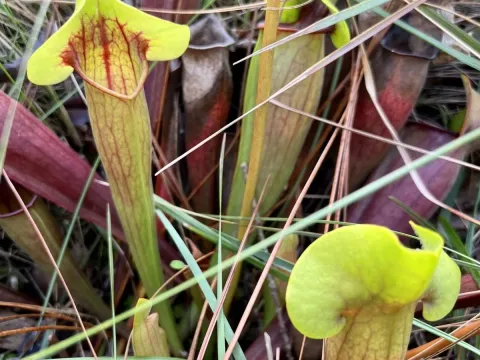
Catesby's Pitcher Plant
Sarracenia catesbaei
Sarracenia catesbaei, known as Catesby's Pitcher Plant, is a classic hybrid carnivorous plant belonging to the Sarraceniaceae family. It is a cross between Sarracenia flava and Sarracenia purpurea, exhibiting beautiful tubular leaves that function as pitfall traps for various insects.
What the section contains
Catesby's Pitcher Plant
To cultivate this species successfully, one must replicate its natural bog habitat. The primary requirement is high-intensity light. These plants should be placed in full sun to ensure robust leaf structure and the development of intense red or purple venation patterns on the pitchers.
The growing medium must be nutrient-poor and acidic. A standard mix consists of peat moss and perlite or horticultural sand. It is vital to avoid any soil containing added fertilizers, as they are toxic to the plant's sensitive roots and can cause rapid necrosis.
Watering requires strict attention to water quality. Only distilled, rainwater, or reverse osmosis water should be used. The pots must stand in a tray with a constant level of water to maintain the moisture levels consistent with a swampy environment.
Winter dormancy is an essential biological phase for this perennial. During the colder months, the plant requires a cooling period where temperatures drop between 2 and 10 degrees Celsius, allowing the rhizome to rest and prepare for the spring growth spurt.
The most significant threat to the health of Sarracenia catesbaei is root rot, usually caused by stagnant water conditions or poor drainage in the potting medium. If the soil becomes overly compact or waterlogged without proper aeration, the rhizome will succumb to fungal decay.
Pests like aphids are common intruders, often clustering around the tender opening of the pitcher. These insects extract plant sap and can weaken the plant if left unchecked, potentially leading to stunted growth or deformation of new leaves.
Spider mites pose a significant risk, particularly in indoor environments with low humidity. They spin fine webs and cause the foliage to lose its vibrant color, eventually leading to the premature death of the pitcher leaf.
Fungal pathogens such as Botrytis may attack during the winter dormancy period if the plant is kept in conditions that are too humid and lack ventilation. Regular inspections are necessary to remove any rotting leaves promptly.
Proper hygiene, such as clearing away dead leaf material and ensuring good air circulation, is the best preventative strategy against disease. Chemical treatments should be used sparingly, as the plant's specialized physiology is sensitive to many common pesticides.