
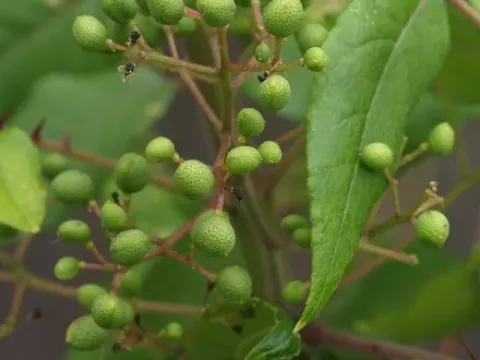
Hercules club
Zanthoxylum clava-herculis
Hercules club (Zanthoxylum clava-herculis) is a deciduous tree belonging to the Rutaceae family, native to the southeastern United States. It is widely recognized for its distinctive, woody, cone-shaped prickles covering the bark of its trunk.
What the section contains
Hercules club
The plant thrives in warm, temperate climates and requires well-drained, fertile soil to reach its maximum growth potential. It is sensitive to extreme frost, which dictates the specific regions where it can be successfully cultivated.
Agricultural success depends on providing full sun exposure, although saplings can tolerate partial shade in their initial years. Soil should ideally be slightly acidic to neutral, rich in organic matter, and kept consistently moist but not waterlogged.
Agrotechnical practices include annual pruning to maintain shape and promote the growth of harvestable bark. Nitrogen-based fertilizers applied in early spring help accelerate the development of vegetative mass during the active growing season.
The economic value of this tree lies in its medicinal properties, specifically the use of bark as a local anesthetic, and its role as a botanical curiosity in landscaping. It serves as a valuable resource for both traditional herbalism and modern botanical research.
The plant is generally robust, but it can be susceptible to various leaf spot diseases if grown in areas with poor airflow and high humidity. Sanitation, including removing fallen infected leaves, is essential to limit fungal spread.
Insect pests such as aphids or scale insects may occasionally infest the young stems and foliage. Integrated pest management strategies are recommended, focusing on biological controls whenever possible to protect the tree's health.
Root rot is a significant threat in poorly drained soils. The development of a proper drainage strategy before planting is the most effective preventative measure against this persistent and dangerous condition.
Weed control is critical during the first two to three years after planting. Competition for nutrients and water with surrounding vegetation will severely handicap the establishment and growth rate of the tree.
Regular monitoring of the bark and root crown is necessary to catch any signs of environmental stress or pest activity early. Keeping the trees healthy through proper nutrition strengthens their natural resistance to pathogens.