
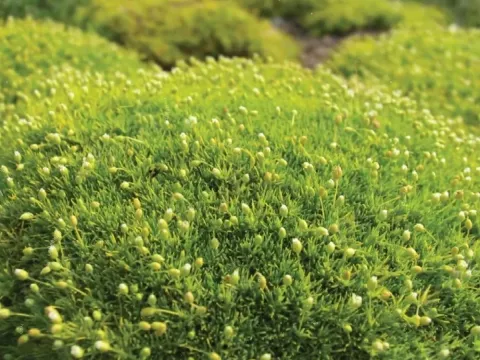
Sagina revelieri
Sagina revelieri
Sagina revelieri, commonly known as a type of pearlwort, belongs to the Caryophyllaceae family. It is a perennial herbaceous plant native to the mountainous regions of the Mediterranean, where it typically thrives in rocky crevices and poor, stony soils.
What the section contains
Sagina revelieri
Botanically, it is recognized for its dense, moss-like cushions and fine, needle-like foliage. It spreads via creeping stems that root at the nodes, allowing it to form a solid, low-growing mat that is highly prized in modern landscaping for its lush, evergreen appearance.
The cultivation of Sagina revelieri requires well-drained soil. It is particularly intolerant of heavy, waterlogged soils, which lead to root rot. Ideally, growers should provide a mixture of sand and organic matter to ensure both moisture retention and optimal drainage for the shallow root system.
Regarding climate requirements, this plant prefers a position with bright, indirect light or partial shade. While it can tolerate full sun in cooler northern climates, excessive midday heat in southern zones may necessitate protective shade to prevent the foliage from browning or drying out.
The primary use of this culture is within the horticultural and landscaping sectors. It is frequently employed as a groundcover for rock gardens, path edges, and as a low-maintenance, aesthetic alternative to grass in areas with minimal foot traffic where a smooth, uniform texture is desired.
The primary threat to Sagina revelieri is the development of fungal infections, most notably root rot. These conditions are predominantly triggered by high humidity levels combined with poor drainage, which causes the dense cushions to remain constantly wet at the base.
Pests, specifically slugs and snails, represent a significant concern for the aesthetics of the plant. These mollusks are attracted to the moist environment created by the dense growth and can consume large portions of the foliage, leaving unsightly gaps in the mat.
To mitigate these risks, irrigation should be carefully managed, ideally performed at the base of the plant to keep the foliage dry. Providing adequate spacing and ensuring good airflow around the cushions is essential to prevent the accumulation of moisture that encourages disease.
For chemical-free pest control, gardeners often employ physical barriers or natural deterrents to keep slugs away from the delicate foliage. Early detection of any browning or patchiness is key, as timely pruning of affected areas can prevent the spread of fungal pathogens.
Weed management remains critical during the establishment phase. As Sagina revelieri grows relatively slowly, competing weeds can quickly overwhelm the young plants. Regular, gentle weeding is required until the mat becomes established enough to naturally suppress competitive invasive species.