
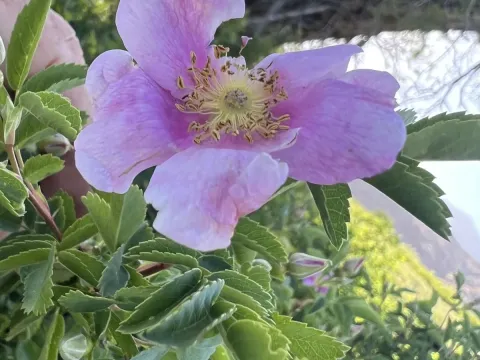
Woods' rose
Rosa woodsii
Woods' rose (Rosa woodsii) is typically propagated via seeds or vegetative cuttings from root suckers. Seeds require a cold stratification period of 3 to 4 months to break dormancy.
What the section contains
Woods' rose
For best results, seeds should be sown outdoors in the autumn, allowing them to undergo natural stratification during winter. Spring sowing requires pre-treatment in a cold storage environment.
Vegetative propagation is commonly performed by separating the root suckers that emerge around the main plant. This process is most effective during the dormant season, either in spring or autumn.
When planting, ensure a spacing of at least 1.5 to 2 meters between individual bushes, as the plant tends to spread significantly due to its aggressive root system.
Seeds should be covered with 2-3 cm of light, well-draining soil. A growing medium composed of peat, sand, and topsoil is ideal for initial seedling development.
Woods' rose is a deciduous shrub belonging to the Rosaceae family, native to North America. It is naturally adapted to diverse landscapes, ranging from forest edges to riverbanks.
The plant thrives in full sun but can tolerate partial shade. Adequate sunlight is essential for vigorous growth and maximizing the production of healthy, nutrient-rich hips.
Soil requirements are relatively flexible; the plant adapts well to sandy, loamy, or rocky substrates. However, good drainage is critical to prevent root rot in waterlogged conditions.
This species is highly cold-hardy and can withstand harsh winter climates. Once established, it demonstrates notable drought tolerance, making it an excellent choice for low-maintenance landscapes.
Annual applications of organic mulch help maintain soil moisture and discourage weed competition. Supplemental organic fertilizer can be applied during early spring to support new growth.
Woods' rose is valued for its nutrient-dense hips, which are rich in Vitamin C and antioxidants. These are commonly used in the food and medicinal industries for syrups and teas.
Productivity increases as the plant matures, with substantial yields usually beginning by the third or fourth year. Peak production is typically reached between the ages of 7 and 10.
In agricultural settings, the species is frequently utilized for erosion control and windbreaks. Its extensive root system provides essential soil stabilization on slopes and riparian zones.
The shrub also acts as a natural habitat and food source for local wildlife, contributing to the overall ecological stability of the farmland or surrounding landscape.
Due to its rapid growth and dense habit, it is an effective biological barrier that can be used to delineate field boundaries or improve the biodiversity of a site.
While generally robust, Woods' rose can be susceptible to powdery mildew, especially in humid conditions. Ensuring proper spacing and airflow helps reduce the incidence of this fungus.
Aphids and spider mites are common pests that target new foliage. Regular scouting is recommended, and intervention should be limited to the early stages of infestation to protect pollinators.
Rust diseases may occur, characterized by orange spots on the leaves. Management involves removing infected plant tissue and applying copper-based fungicides during the dormant phase.
Preventive maintenance, such as cleaning up fallen leaves and practicing proper pruning, is essential to minimize the overwintering of pathogens and insect larvae near the plants.
Careful monitoring of soil nutrient levels is advised, as excessive nitrogen can create succulent growth that is more prone to pest attacks and fungal infections.
Harvesting should take place when the hips are fully ripe and display a vibrant red color, typically occurring in late summer or early autumn before the first frost.
The fruits must be harvested in dry weather to ensure quality and prevent spoilage. Avoid using metal implements to harvest; hand-picking is preferred to protect the plant.
Post-harvest processing requires immediate drying or preparation. If drying, keep temperatures between 50-60 degrees Celsius to preserve the vital chemical composition of the hips.
Store dried hips in breathable containers, such as paper bags, in a cool, dry, and dark environment to maintain their shelf life and prevent moisture absorption.
It is important to practice sustainable harvesting, leaving a portion of the crop for local wildlife, as the hips remain a critical energy source for birds during the winter months.