
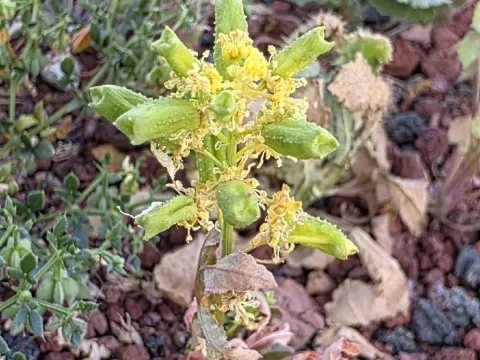
Reseda crystallina
Reseda crystallina
Reseda crystallina belongs to the Resedaceae family. This herbaceous plant is evolutionarily adapted to the extreme conditions of arid regions, which defines its unique metabolism and physiological resilience.
What the section contains
Reseda crystallina
In its natural habitat, the crop is found in desert and semi-desert zones of North Africa. The plant demonstrates high tolerance to saline soils and prolonged drought, making it a subject of interest for research in dryland farming.
For successful growth, Reseda requires light, well-drained sandy or sandy-loam soils. It is extremely sensitive to excessive root moisture, so selecting a site with a deep water table is a critical success factor.
The plant prefers open areas with intense solar exposure. The optimal temperature range for vegetation is between +20 and +35 degrees Celsius, although the culture can withstand significant diurnal temperature fluctuations.
Botanically, the species is characterized by the presence of papillary outgrowths on the leaves and stems, which give the plant a crystal-like appearance. This feature helps the plant retain moisture and minimize transpiration in extreme heat.
Sowing of Reseda crystallina is recommended during a period when the soil is sufficiently warmed, which typically coincides with the beginning of the spring season. In arid climates, late-autumn sowing is also feasible if the seeds have sufficient germination vigor.
The seeding depth should not exceed 1–2 centimeters, as the fine seed material requires a shallow position to ensure proper access to oxygen and light. Excessive depth leads to a significant decrease in germination rates.
Sowing is carried out in rows with wide spacing. This is necessary to ensure that each plant receives maximum sunlight and has an adequate nutritional area, eliminating competition for limited moisture resources.
After the emergence of seedlings, thinning is performed, maintaining a distance of at least 20–30 centimeters between plants. This is a critical stage of agricultural management that allows for an optimal plant stand density.
To accelerate seed germination in commercial scales, pre-soaking in growth stimulants may be used. However, when dealing with wild-type forms, it is essential to consider the natural dormancy mechanisms of the seeds.