
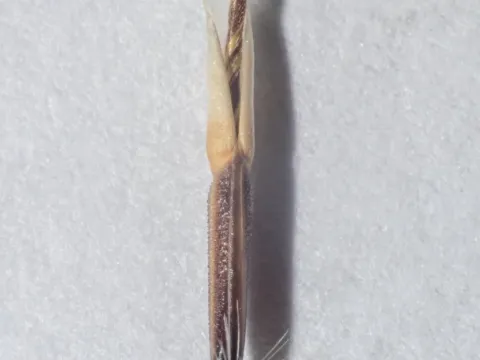
Charrua needlegrass
Stipa charruana
Charrua needlegrass is a perennial grass species typically sown in the spring when soil temperatures reach 10-12 degrees Celsius.
What the section contains
Charrua needlegrass
Successful germination requires sufficient moisture in the topsoil layer, which is why early spring sowing is common in arid regions.
Seeds are sown at a depth of 2-3 centimeters, as small seeds require firm contact with moist soil to ensure uniform emergence.
When sown in late autumn, seeds undergo natural stratification, which promotes more consistent growth in the spring, although this requires careful weed control.
The seeding rate is determined by seed purity and germination percentage, generally ranging from 8 to 12 kilograms per hectare for drill sowing.
The Stipa charruana crop is a typical representative of South American steppe flora, possessing high ecological plasticity in open space environments.
The plant prefers well-drained sandy or sandy-loam soils and cannot tolerate waterlogging or high groundwater levels.
The optimal pH range for cultivating this species is between 6.0 and 7.5, aligning with neutral or slightly alkaline soil types.
Charrua needlegrass is highly drought-tolerant and heliophilic, requiring direct sunlight throughout the day for optimal development.
In its natural habitat, the plant withstands significant daily temperature fluctuations characteristic of continental climates.
The green mass yield of charrua needlegrass significantly depends on the level of precipitation during the growing season and local soil fertility.
Under cultivation conditions with regular mineral fertilizer application, it is possible to achieve stable forage harvesting twice per season.
The primary yield consists of vegetative mass used for hay, which offers moderate nutritional value for livestock.
Nutritional value drops sharply as the plant enters the flowering phase, making timely harvesting critical for high-quality hay production.
The crop's productivity potential is fully realized in its third year, once the root system achieves maximum development and penetration depth.
Major phytopathological problems include fungal diseases, such as cereal rust, which develops under conditions of high air humidity.
Root rot can affect crops if crop rotation practices are not followed or if the soil becomes excessively waterlogged in the spring.
Among pests, larvae of ground beetles and various cereal flies pose the greatest danger, as they damage root systems and young shoots.
To minimize risks, pre-sowing seed treatment with fungicides is necessary, alongside constant monitoring of the phytosanitary status of neighboring fields.
Rodents can also cause damage by feeding on seeds during the maturation phase, requiring preventive control measures on large-scale plantations.
Mowing charrua needlegrass for hay should be performed during the heading phase, before the stems mature and become too coarse.
When harvesting, it is important to use equipment that mows low but does not damage the tillering nodes, allowing for quick regrowth for subsequent grazing.
Freshly mown mass should be dried promptly in windrows to preserve maximum nutrients and prevent spoilage.
Seed harvesting is conducted when the seeds reach wax ripeness and the panicles acquire their characteristic straw-colored hue.
Using combines with a low-speed threshing drum prevents damage to the seed coat, thereby increasing germination rates for future planting cycles.