
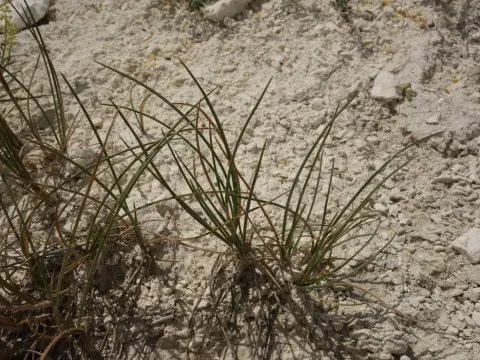
Chalk fescue
Festuca cretacea
Chalk fescue (Festuca cretacea) is a perennial grass species belonging to the Poaceae family. It is a highly specialized plant that is naturally adapted to harsh environments, particularly on chalk and limestone outcrops, which are often nutrient-poor.
What the section contains
Chalk fescue
This species is known for its remarkable resilience and ability to thrive in alkaline, calcareous soils where other grasses struggle. Its robust root system allows it to stabilize loose soil and prevent erosion on steep, rocky slopes.
The plant demands full sun to maintain its structural integrity and health. In shade, the density of the tussocks significantly decreases, leading to weaker growth and increased susceptibility to environmental stress.
For successful growth, well-drained soil is essential. Chalk fescue is extremely intolerant of waterlogged conditions, which can lead to rapid root decay. It performs best in sandy or gravelly loam soils with adequate calcium content.
As a steppe-adapted species, it demonstrates high tolerance for extreme temperature fluctuations and long periods of drought, making it an excellent candidate for low-maintenance landscapes and restoration projects.
The optimal time for sowing is during the early spring or late autumn. This timing allows the seeds to take advantage of natural moisture cycles, which is critical for successful establishment in arid environments.
Seeds should be planted at a shallow depth of approximately 1 centimeter. Due to their small size, they require careful handling and a well-prepared seedbed that is free of competing weeds to ensure successful germination.
Once sown, the soil surface should be lightly compacted to ensure good seed-to-soil contact. This step is particularly important in windy or sloped locations where seeds could otherwise be easily washed or blown away.
Establishment is relatively slow, as the plant prioritizes root development in its first year. During this time, the area should be kept relatively free of invasive weeds to ensure the young fescue seedlings can grow without competition.
After the initial establishment phase, the plants become incredibly self-sufficient. Supplemental irrigation is generally only required during prolonged, severe droughts in the first season of growth.
Chalk fescue is naturally resistant to many of the common fungal pathogens, such as rusts and smuts, that affect more sensitive forage grass varieties. Its toughened leaf blades and low-nutrient requirements contribute to this natural immunity.
The main threat to new plantings is competition from aggressive, fast-growing weeds. If these are not controlled early on, they can easily overtop the slow-developing fescue and suppress its growth entirely.
While the plant is quite hardy, severe winter conditions combined with high rodent populations can lead to mechanical damage, as rodents may feed on the crowns or roots under the cover of deep snow.
To maintain a healthy stand, it is important to avoid over-fertilization, as this can encourage the growth of weed species and weaken the fescue’s natural adaptation to its preferred low-nutrient soil conditions.
Integrated pest management should focus on mechanical weed removal in the early stages of growth and ensuring that drainage systems are properly maintained to prevent any risk of root-zone moisture accumulation.