
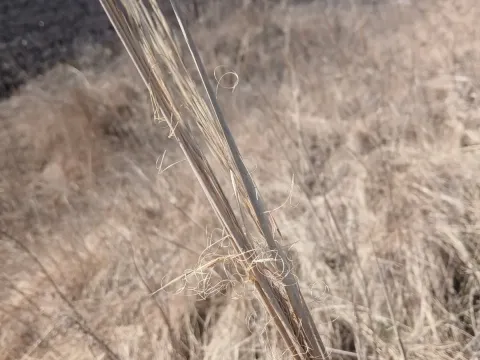
Feather grass
Stipa capillata
Feather grass, scientifically known as Stipa capillata, belongs to the Poaceae family. It is a perennial, densely tufted bunchgrass that is a cornerstone species of grassland ecosystems. In nature, it reproduces via seeds that utilize a specialized hygroscopic awn to drill themselves into the soil.
What the section contains
Feather grass
When cultivated, seeds are typically sown in early spring or late autumn. The soil should be well-prepared and free of competitive weeds. Seed burial depth must be shallow, as the small seeds lack the energy reserves required to emerge from deep within the soil profile.
Seedling development is slow, and the plants require diligent weed control during their first two years. During this establishment phase, the plant focuses primarily on developing its deep and robust root system to survive future environmental stresses.
The standard seeding rate varies depending on the desired plant density, usually ranging from 6 to 10 kg per hectare. Precision seeding equipment is recommended to ensure even distribution and proper soil contact.
Field germination rates depend heavily on soil moisture levels during the sowing window. A gentle covering of soil combined with optimal spring moisture significantly improves the success rate of new plantations.
This grass is a classic xerophyte, meaning it is perfectly adapted to arid environments. It thrives in open, sunny locations with high solar radiation and is highly resistant to prolonged drought and extreme summer temperatures.
Stipa capillata is not demanding regarding soil fertility and can successfully grow on rocky, calcareous, or eroded soils. It prefers neutral to slightly alkaline pH levels and performs poorly in acidic or waterlogged environments.
Proper drainage is the most critical requirement for its cultivation. The species cannot tolerate stagnant water in the root zone, which leads to root rot and eventual plant dieback during the winter or spring months.
The species exhibits excellent winter hardiness, allowing it to survive extreme temperature fluctuations. It is well-suited for regions with continental climates where other forage grasses might fail to survive the harsh conditions.
In agricultural settings, it is best utilized for the reclamation of degraded lands or as a permanent pasture component in areas where high-input crops are not viable due to terrain or soil constraints.
The biomass yield of Stipa capillata is moderate compared to intensive forage crops, but it remains a reliable source of green mass in regions with severe water limitations. Its nutritional quality is highest during the early vegetative stage.
It is primarily utilized as spring pasture for livestock. While it is highly palatable early in the season, the forage quality declines rapidly as the plant matures and the stems become rigid and high in fiber content.
Seed yield varies annually based on the timing and quantity of spring precipitation. Favorable weather conditions promote the development of numerous reproductive tillers, allowing for efficient commercial seed harvesting.
Beyond its value as forage, the grass is highly effective in soil erosion control. Its dense root network binds soil particles together, making it an excellent candidate for the restoration of steep slopes and abandoned agricultural land.
A balanced application of potassium and phosphorus can improve stand longevity, though nitrogen fertilization should be managed carefully to avoid stimulating weed competition at the expense of the feather grass.
Feather grass is generally robust and rarely suffers from catastrophic disease outbreaks in its native habitat. However, in dense monoculture plantations, powdery mildew or rust can occur if humidity levels remain high for extended periods.
Common insect pests include grain flies and various aphids that may target the developing seed heads or tender foliage. These infestations are typically minor and do not require intensive chemical control measures.
The primary threat to Stipa capillata is competition from invasive weeds and aggressive perennials. If not controlled in the early stages, these weeds can outcompete the feather grass and lead to the loss of the stand.
Intensive overgrazing, especially during the flowering and seed-set phase, prevents natural regeneration and weakens the plant, eventually leading to the depletion of the local population.
Rodent activity during the winter months can cause physical damage to the root crowns. While isolated damage is common, widespread rodent pressure can occasionally result in stand thinning.
Harvesting Stipa capillata seeds is a challenging technical task due to the non-simultaneous ripening of the seed heads and the plant's natural tendency to disperse seeds quickly upon maturity.
The optimal time for seed harvest is marked by the distinct twisting of the awns and a change in seed color to dark brown. Harvesters must be calibrated to a low drum speed to avoid damaging the delicate seeds.
When harvested for hay, the grass should be cut during the boot stage or very early heading. Delayed harvesting results in poor-quality hay that is difficult for livestock to consume due to the sharp, rigid awns.
Post-harvest, the seed material requires immediate cleaning and drying. Because of the long awns, specialized mechanical de-awning equipment is often used to facilitate easier sowing and distribution in the field.
Storage conditions must prioritize low humidity, as high moisture levels can quickly degrade seed viability by promoting fungal growth and microbial activity within the stored material.