

Reference · Crops
Fescue
Festuca L.
Fescue is typically sown in early spring or late autumn to allow the root system to establish itself before the onset of extreme seasonal temperatures.
31
items
What the section contains
 Meadow fescue
Festuca pratensis Huds.
18 products
Meadow fescue
Festuca pratensis Huds.
18 products
 Blue fescue
Festuca glauca Vill.
Blue fescue
Festuca glauca Vill.
 Chewing's fescue (or shade fescue)
Festuca heterophylla Lam.
Chewing's fescue (or shade fescue)
Festuca heterophylla Lam.
 Chewings fescue
Festuca rubra L. subsp. commutata Markgr.-Dann.
Creeping red fescue
Festuca rubra L. var. littoralis Vasey
Creeping Red Fescue
Festuca rubra L. subsp. pruinosa (Hack.) Piper
Chewings fescue
Festuca rubra L. subsp. commutata Markgr.-Dann.
Creeping red fescue
Festuca rubra L. var. littoralis Vasey
Creeping Red Fescue
Festuca rubra L. subsp. pruinosa (Hack.) Piper
 Danthon's Fescue
Festuca danthonii Asch. & Graebn.
Danthon's Fescue
Festuca danthonii Asch. & Graebn.
 False Dalmatian fescue
Festuca pseudodalmatica Krajina ex Domin
False Dalmatian fescue
Festuca pseudodalmatica Krajina ex Domin
 False sheep's fescue
Festuca pseudovina Hack. ex Wiesb.
False sheep's fescue
Festuca pseudovina Hack. ex Wiesb.
 Festuca gautieri
 (Hack.) K. Richt.
Festuca gautieri
Festuca gautieri (Hack.) K. Richt.
 Festuca valesiaca
 Schleich. ex Gaudin subsp. valesiaca
Festuca valesiaca
Festuca valesiaca Schleich. ex Gaudin subsp. valesiaca
 Fine-leaved sheep's fescue
Festuca filiformis Pourr.
Fine-leaved sheep's fescue
Festuca filiformis Pourr.
 Giant fescue
Festuca gigantea (L.) Vill.
Giant fescue
Festuca gigantea (L.) Vill.
 Hard fescue
Festuca trachyphylla (Hack.) Hack.
Hard fescue
Festuca trachyphylla (Hack.) Hack.
 Hard fescue
Festuca longifolia Thuill.
Hybrids of Festuca idahoensis and Festuca ovina
hybrids between Festuca idahoensis Elmer and Festuca ovina L.
Hard fescue
Festuca longifolia Thuill.
Hybrids of Festuca idahoensis and Festuca ovina
hybrids between Festuca idahoensis Elmer and Festuca ovina L.
 Idaho fescue
Festuca idahoensis Elmer
Idaho fescue
Festuca idahoensis Elmer
 Leman's fescue
Festuca lemanii T. Bastard
Leman's fescue
Festuca lemanii T. Bastard
 Rat's-tail fescue
Festuca myuros L.
Red fescue
Festuca rubra L.
Red fescue
Festuca rubra L. subsp. rubra
Rat's-tail fescue
Festuca myuros L.
Red fescue
Festuca rubra L.
Red fescue
Festuca rubra L. subsp. rubra
 Sheep fescue
Festuca ovina L.
Sheep fescue
Festuca ovina ssp supina
Sheep fescue
Festuca ovina ssp. vulgaris
Sheep fescue
Festuca ovina L.
Sheep fescue
Festuca ovina ssp supina
Sheep fescue
Festuca ovina ssp. vulgaris
 Sprawling fescue
Festuca rupicola Heuff.
Sprawling fescue
Festuca rupicola Heuff.
 Tall fescue
Festuca arundinacea Schreb.
Tall fescue
Festuca arundinacea Schreb.
 Tall fescue
Festuca arundinacea Schreb. subsp. arundinacea
Tall fescue
Festuca arundinacea Schreb. subsp. orientalis (Hack.) K. Richt.
Volesian fescue
Festuca valesiaca Schleich. ex Gaudin
Tall fescue
Festuca arundinacea Schreb. subsp. arundinacea
Tall fescue
Festuca arundinacea Schreb. subsp. orientalis (Hack.) K. Richt.
Volesian fescue
Festuca valesiaca Schleich. ex Gaudin
 Vulpia bromoides
Festuca bromoides L.
Vulpia bromoides
Festuca bromoides L.
 Vulpia fasciculata
Festuca fasciculata Forssk.
Vulpia fasciculata
Festuca fasciculata Forssk.
Marketplace
Products in this section · 12


Fertilizer based on humic acids «Potassium Humate EcoOrganika»
Fertilizers
0
0
2 offers
3.86 €per 1 kg
Buy

Fescue
Seedbed preparation requires a fine and firm surface, as fescue seeds are relatively small and need adequate soil-to-seed contact for germination.
Seeding rates range significantly depending on the intended use, varying from 12 kg per hectare for pastures to over 30 kg per hectare for dense turf applications.
A sowing depth of 1 to 2 centimeters is optimal; planting deeper often leads to poor emergence rates due to the limited energy reserves within the seeds.
Inter-seeding with legumes can improve the nutritional profile of the forage, provided the grass growth rate is balanced to avoid competition during establishment.
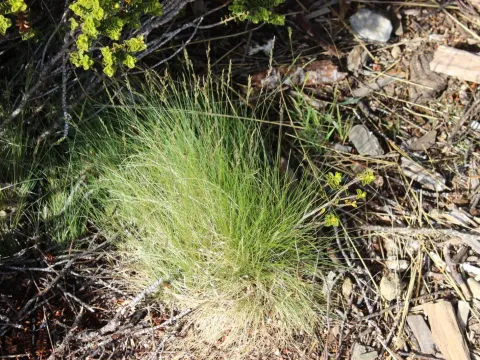
Fescue belongs to the Poaceae family and is recognized for its remarkable environmental adaptation, thriving in a wide range of climatic conditions.
The plant is highly regarded for its drought tolerance, which is facilitated by an extensive and deep-reaching root system capable of accessing subsurface moisture.
While fescue adapts well to various soil types, it performs best in well-drained loamy soils with a neutral or slightly acidic pH level.
Cold tolerance is one of the key characteristics of many Festuca species, making them suitable for cultivation in mountainous regions and cold climates.
Although it is a hardy crop, fescue responds positively to balanced fertilization, particularly nitrogen, which supports rapid regrowth after grazing or harvesting.
The biomass yield of fescue can reach between 15 and 25 metric tons per hectare under favorable management practices and adequate soil fertility levels.
Seed production yields are typically in the range of 500 to 800 kilograms per hectare, depending on the variety and local climatic conditions during the flowering phase.
Regular mowing or grazing management is essential to keep the grass in a vegetative state, thereby maximizing the overall yield of high-quality forage.
Irrigation significantly stabilizes yield in arid regions, preventing the early maturation that can otherwise degrade the nutritional quality of the forage.
Given proper soil care and rotational management, fescue stands can remain productive for several years, providing a consistent source of livestock feed.
Powdery mildew is a common fungal disease affecting fescue, particularly in dense stands with poor airflow and high humidity levels during the growing season.
Rust diseases can cause significant damage to the leaf tissue, reducing the photosynthetic capacity and overall nutrient density of the grass foliage.
Root rot is often associated with poor drainage, which stresses the plant and creates favorable conditions for soil-borne pathogens to thrive.
Common insect pests include various species of flies and larvae that may target the stems or reproductive structures of the plant during development.
Integrated pest management strategies, such as selecting resistant cultivars and maintaining optimal stand density, are the most effective ways to mitigate these threats.
Harvesting for forage should occur during the boot stage, as this ensures the highest concentration of crude protein and digestible energy for livestock.
Using mechanical conditioners during the harvesting process can significantly decrease drying time, preserving the nutrient value and color of the hay.
For seed crops, harvesting must be timed precisely to avoid excessive shattering losses that occur as the seeds reach full maturity on the stalk.
Swathing is the preferred method for seed production, allowing the material to dry uniformly in the field before it is gathered for final threshing.
Post-harvest conditioning includes thorough cleaning and moisture adjustment to 12-14% to ensure safe, long-term storage of the seed lots.