
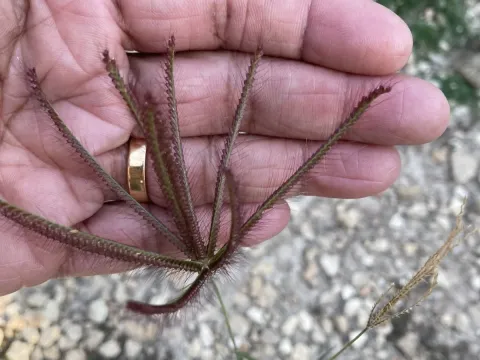
Feather fingergrass
Chloris barbata
Feather fingergrass is primarily propagated by seeds, which require warm soil conditions for optimal germination. Sowing should occur when temperatures consistently remain between 20°C and 30°C, typically at the onset of the rainy season.
What the section contains
Feather fingergrass
The seeds are extremely small, necessitating a shallow sowing depth of less than 1 centimeter. Broadcasting the seeds onto a prepared seedbed followed by light rolling is the most effective method for establishment in large areas.
Seed rates usually range from 5 to 8 kilograms per hectare, depending on the desired density and local environmental conditions. Proper seed-to-soil contact is critical to ensure uniform emergence in tropical climates.
This grass can also be established through vegetative propagation if necessary, but direct seeding remains the standard for large-scale agricultural projects. Initial weed suppression is vital during the first few weeks of growth.
Once established, Chloris barbata is highly capable of self-seeding, which helps maintain permanent pastures without the need for frequent re-sowing in well-managed grazing systems.
As a member of the Poaceae family, Chloris barbata is highly adapted to tropical and subtropical environments. It thrives in full sunlight, which is essential for maximizing its vegetative growth and overall nutrient content.
The species shows remarkable soil adaptability, growing successfully on sandy, clayey, and degraded soils. It is particularly valued for its tolerance to saline conditions and low-fertility environments where other grasses might fail.
Drought resistance is one of its most defining characteristics, allowing the plant to remain green and productive even during extended dry spells. Its deep-reaching root system effectively taps into soil moisture reserves.
Proper drainage is necessary, as the plant does not tolerate waterlogging for prolonged periods. It is strictly a warm-season grass and will suffer damage or complete death if exposed to freezing temperatures.
Strategic application of nitrogenous fertilizers can significantly boost biomass yield on poor soils, enhancing the protein content of the foliage and making it a more valuable feed for livestock.
The biomass yield of feather fingergrass is highly responsive to favorable moisture levels and can reach 10–15 tons of dry matter per hectare annually. Its fast growth rate allows for multiple cuts throughout the active growing season.
When used for grazing, it exhibits excellent recovery after being harvested by livestock. Frequent but controlled grazing prevents the grass from becoming overly stemmy and lignified, thereby maintaining its digestibility.
Seed production is generally robust, with potential yields of up to 400 kilograms per hectare on dedicated seed production plots. Harvesting must be timed precisely to prevent significant loss due to seed shattering.
Economic value is driven by its low-maintenance requirements, as it is a vigorous competitor that naturally suppresses most annual weeds, reducing the need for costly chemical interventions.
The total yield potential is highest in environments with a well-defined wet season, where rapid metabolic activity allows for the accumulation of significant amounts of forage in a short period.
Chloris barbata is generally resistant to many common grass diseases, but it may occasionally be affected by rust or smut fungi, especially under conditions of high humidity and poor air circulation within the canopy.
Pests such as armyworms or grasshoppers may feed on the foliage during population outbreaks, although they rarely cause permanent damage to a healthy, well-established stand of this grass.
Root-knot nematodes can occasionally hinder plant development in monoculture systems. Implementing a crop rotation scheme with legumes or other non-host species is the recommended strategy for mitigation.
Overgrazing poses a more significant threat than pests, as it can lead to soil compaction and thinning of the stand. Sustainable management practices must prioritize maintaining a sufficient leaf area index for regrowth.
Environmental stressors such as extreme heat combined with high winds can accelerate transpiration, temporarily reducing yield, though the species is evolutionarily equipped to bounce back quickly.
For high-quality hay, harvesting should occur during the late boot to early flowering stage. Cutting at this time ensures the best balance between protein concentration and crude fiber content.
The mowing height should be maintained at roughly 5–10 centimeters to prevent damage to the crown, which facilitates quick regrowth and maintains the long-term vigor of the pasture.
Post-harvest, the grass should be raked into windrows and allowed to dry thoroughly in the sun. Given its preferred climate, drying is usually rapid, minimizing the risk of mold formation.
Seeds are harvested using specialized machinery once the heads turn a dull color. Gentle handling is required during the threshing process to preserve seed viability and prevent mechanical damage.
Final storage of both forage and seed should be in cool, dry, and ventilated facilities to prevent moisture buildup and ensure longevity of the products throughout the year.