
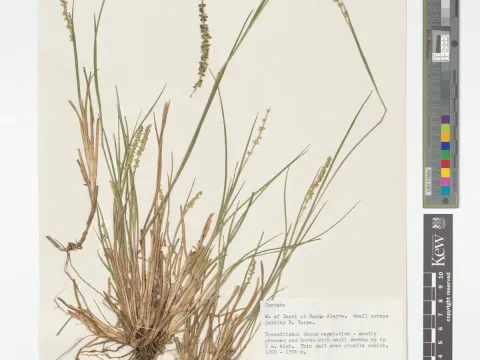
Setaria vaginata
Setaria vaginata
Setaria vaginata is a warm-season grass that requires stable soil temperatures to germinate effectively. Sowing should commence only after the danger of late spring frost has completely passed and soil temperatures have reached at least 15 degrees Celsius for consistent emergence.
What the section contains
Setaria vaginata
Seedbed preparation must be thorough to ensure good contact between the soil and the fine seeds. Planting depth should be maintained between 2 to 3 centimeters, as burying the seeds too deeply will delay emergence or cause total failure of the crop stand.
The seeding rate is usually calculated based on the desired plant density and local soil fertility. Generally, a density of several hundred plants per square meter is targeted to ensure a competitive stand that effectively suppresses weed growth during the early stages of development.
Row spacing of approximately 15 centimeters is standard for this crop to facilitate uniform growth and ease of maintenance. When growing for seed production, wider spacing may be utilized to allow for better airflow and easier weed control between the crop rows.
Post-sowing rolling is highly recommended to improve capillary moisture movement toward the seeds. This step is particularly vital in regions where spring rainfall is erratic, as it ensures that the seeds have sufficient moisture to initiate and sustain germination.
As a warm-season grass, Setaria vaginata demands high solar radiation and stable temperatures to reach its maximum productivity. It performs best in regions with long, hot summers where growth rates remain high due to efficient photosynthetic pathways common in this genus.
The crop is adaptable to a variety of soil types but thrives in well-drained loams and fertile silt soils. Heavy clay soils that tend to waterlog are unsuitable and will result in stunted root development and poor overall crop performance throughout the growing season.
Water requirements are significant during the peak vegetative stage, specifically during the tillering and stem elongation phases. While the plant exhibits some drought tolerance, supplemental irrigation during prolonged dry spells will substantially increase the total green biomass yield.
Belonging to the Poaceae family, the plant responds positively to nitrogen fertilization, which should be applied early in the growth cycle. A balanced nutrient program ensures vigorous tillering and robust development, leading to a denser and more nutritious forage harvest.
This grass is highly sensitive to shading, making it unsuitable for intercropping with tall, light-competing species. Providing open, sunny conditions is essential for the plant to express its full genetic potential and maintain high nutritional content in its leaves and stems.
Yield potential of Setaria vaginata is largely determined by soil fertility and the timing of agronomic interventions. Under optimal management practices, the crop is capable of producing significant amounts of high-quality biomass suitable for hay or silage production.
Average green biomass yields range from 20 to 35 tonnes per hectare depending on the season and the amount of precipitation received. Multi-cut systems can be employed in warmer climates, allowing for a second harvest and increasing the overall annual forage output.
Seed yield is a critical factor for producers looking to sustain their own supply. Under proper management, the crop can produce between 800 and 1,500 kilograms of seed per hectare, which is sufficient to meet requirements for future planting cycles without needing external inputs.
The nutritional quality of the forage is directly linked to the harvest timing. Harvesting at the early booting stage ensures the best balance between protein content, digestibility, and total volume, as delaying the harvest leads to significant lignification of the stalks.
When preserved as silage, the crop maintains its nutritional integrity, provided the fermentation process is managed correctly. Its composition makes it a highly palatable feed option for cattle and sheep, contributing to better weight gain and overall animal health.
Diseases such as rust and smut are the primary threats to Setaria crops, especially in areas with high humidity. Preventive measures such as using certified, treated seeds and maintaining appropriate crop rotation cycles are essential to reduce the risk of infection.
Insect pests, including cereal flies and aphids, can cause substantial damage by feeding on young seedlings and tender stems. Frequent scouting of the fields during the early vegetative stage allows for early intervention, preventing widespread infestation and yield loss.
Stem borers pose a serious risk during the mid-summer period, as they can burrow into the stalks and weaken the plant's structural integrity. This damage often leads to lodging, making the crop difficult to harvest and reducing the quality of the green biomass.
Weed competition is the most significant challenge during the emergence phase. Because the initial growth of Setaria can be slow, keeping the field clean from invasive broadleaf and grass weeds is necessary to prevent them from outcompeting the crop for light and nutrients.
Integrated Pest Management (IPM) strategies, which prioritize cultural and biological controls, are the most effective way to manage these threats. By keeping the crop healthy and rotating fields, the reliance on synthetic chemicals can be kept to a minimum.
Harvesting for forage should occur during the booting or early heading stage, before the plant begins to shift its energy into flower production. This timing ensures the highest protein and sugar levels, which are critical for high-quality ruminant feed.
The use of a mower-conditioner is standard practice for creating hay, as it speeds up the drying process by crushing the stems. Faster moisture loss reduces the time the crop is exposed to the elements, preventing potential spoilage or mold development.
Seed harvesting requires patience and precision, as the crop must be allowed to reach full physiological maturity without losing too much grain to shattering. Once the seeds reach the hard dough stage, direct combining is the most efficient method for collection.
Proper combine settings are vital, particularly the adjustment of the fan speed and the sieve size to account for the small size of the seeds. Excessive fan speed will blow away a significant portion of the harvest, while improper sieves will lead to seed contamination.
Storage of the final product must occur in a dry and pest-free environment to maintain longevity and germination rates. For seed batches, monitoring moisture levels throughout the storage period is necessary to ensure the material remains viable for future use.