
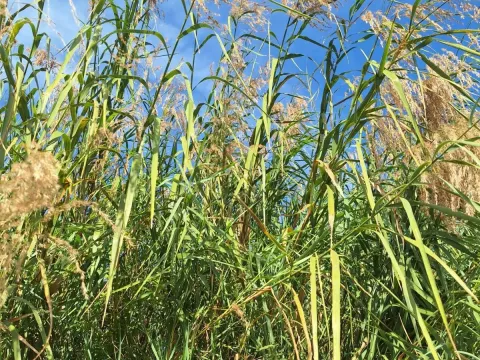
Mauritian reed
Phragmites mauritianus
Mauritian reed (Phragmites mauritianus) is a perennial grass belonging to the Poaceae family. This robust plant is naturally adapted to moist environments, including riverbanks, lake margins, and wetlands, where it can thrive in saturated soil conditions.
What the section contains
Mauritian reed
The native range of this species spans tropical and southern Africa, as well as several islands in the Indian Ocean. Its ecological resilience allows it to adapt to diverse tropical climates, provided there is consistent access to water.
Optimal growth requires high light intensity; the plant is highly photophilous and performs poorly under shade. Therefore, clear, open areas are necessary for establishing productive stands of this reed variety.
The plant prefers fertile, alluvial soils with a neutral or slightly acidic pH. It demonstrates a remarkable tolerance for waterlogged soils and can survive in areas with moderate salinity, which provides an advantage in diverse agricultural settings.
Cultivation practices involve vegetative propagation via rhizomes, which is the most reliable method for field establishment. Proper spacing is essential to ensure adequate air circulation and to facilitate early-stage weed management before the canopy closes.
The yield of Mauritian reed is primarily measured by the production of dry biomass. Under optimal conditions, the plant displays rapid growth rates, generating large volumes of cellulose-rich stems suitable for various commercial purposes.
In agriculture, the reed serves as a source of coarse forage for livestock, particularly in regions where green pasture is limited. While less nutritious than traditional grasses, it provides essential fiber when harvested at the vegetative stage.
The stems of Phragmites mauritianus are known for their mechanical strength and durability. These characteristics make them a preferred material for roofing, fencing, and traditional handicraft production, such as basketry and mat weaving.
Recently, the species has gained interest as a potential feedstock for bioenergy production. Its high biomass output per hectare and ability to grow on marginal land make it an excellent candidate for renewable fuel source development.
Beyond its economic value, the plant plays a crucial role in water management. By stabilizing banks and absorbing excess nutrients, it acts as a biological buffer, protecting agricultural fields from erosion and contributing to cleaner water systems.
Fungal infections are the most common health threats, especially in areas with stagnant air and high humidity. These pathogens can cause leaf spots and stem rots, which directly degrade the quality of the harvested material.
Insect pests, such as stem-boring caterpillars, pose a significant risk to the commercial value of the crop. By tunneling through the stems, these insects compromise the structural integrity of the plant, rendering it unusable for building applications.
Over-exploitation or failure to manage the water cycle can lead to a decline in stand vitality. Regular rotation or periodic rejuvenation of the planting site is recommended to maintain the soil fertility and minimize the buildup of site-specific diseases.
Severe drought conditions represent an existential threat to the crop, as the species relies heavily on consistent moisture for its metabolic processes. While resilient, prolonged exposure to arid conditions can lead to rhizome desiccation.
Effective pest management should prioritize integrated approaches, focusing on mechanical removal and the promotion of natural beneficial insects. Chemical applications should be avoided to prevent pollution of the aquatic ecosystems where this plant resides.