
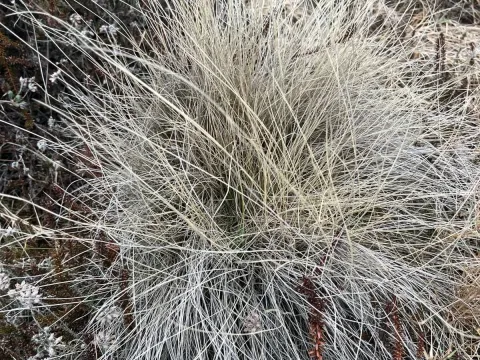
Matgrass
Nardus
Matgrass (Nardus stricta) is a perennial grass species belonging to the Poaceae family. It is the only member of the genus Nardus, notable for its dense, tufted growth habit which creates tough, elevated clumps known as tussocks.
What the section contains

Matgrass
The plant originates from Europe, North Africa, and parts of Asia and North America. It is most commonly found in nutrient-poor, acidic soils, such as heathlands, mountain pastures, and peat-rich meadows where competing grasses struggle to survive.
Regarding climate requirements, Matgrass is highly resilient to cold and moisture. Its ability to tolerate low soil pH levels makes it a characteristic species of alpine grasslands and degraded areas that require restoration through natural succession.
Botanical features include narrow, bristle-like leaves that are rolled tightly to reduce transpiration. The root system is deep and fibrous, allowing the plant to stabilize the soil and persist in harsh conditions throughout the winter months.
In agricultural practice, Matgrass is generally considered low-quality forage. Due to its high silica content and rough texture, livestock typically avoid it, leading to its spread in pastures that suffer from overgrazing and poor nutrient management.
Matgrass is rarely affected by typical crop pests or major agricultural diseases, primarily because it thrives in environments that are not conducive to common plant pathogens.
The high silica content in its foliage acts as a natural mechanical defense against herbivorous insects and smaller agricultural pests.
Environmental threats to Matgrass involve habitat loss due to land development and changes in soil chemistry through the application of heavy fertilizers or lime.
When Matgrass becomes invasive in managed pastures, the primary control measure is to improve soil fertility and implement rotational grazing strategies.
No chemical pesticides are specifically formulated for Matgrass, as it is not a commercially cultivated crop but rather a component of natural ecosystems.