
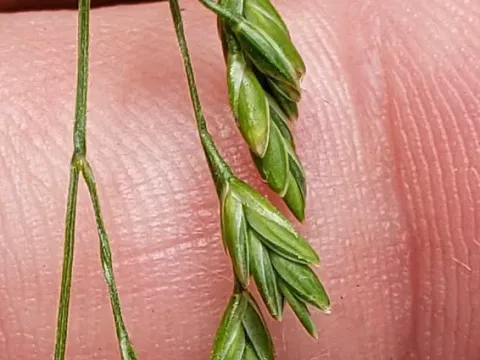
Manna grass
Glyceria
Sowing of Manna grass is typically performed in early spring or late summer, ensuring the soil remains moist to facilitate rapid germination and seedling establishment.
What the section contains


Manna grass
Seeds are small, necessitating shallow placement in the soil, ideally at a depth not exceeding 1 to 2 centimeters to ensure access to essential surface moisture.
Preparation of the seedbed should involve light rolling after seeding, which is crucial for promoting capillary water movement and enhancing the contact between seed and soil.
The seeding rate should be calibrated according to the desired density, keeping in mind the plant's ability to propagate vigorously through creeping rhizomes later in the season.
Optimal sowing conditions involve calm weather to prevent the scattering of seeds, as their light weight can cause significant drift even in mild winds.
Manna grass belongs to the Poaceae family and is highly valued for its natural adaptation to saturated, wetland, and frequently flooded environments.
It thrives best in soil types ranging from alluvial silts to nutrient-rich peat, where it can sustain growth under conditions that exclude most other commercial grasses.
The species requires substantial moisture throughout the growing season, making it an excellent choice for riparian zones, floodplains, and poorly drained depressions.
While tolerant of semi-shaded conditions, Manna grass reaches peak productivity in full sun, where it utilizes its potential for rapid vegetative spread.
Adaptability to temperate climates makes it a reliable perennial forage source, capable of overwintering well in various northern hemispheric regions.
The yield of green biomass depends largely on water table stability and soil fertility, with averages ranging between 15 and 25 tonnes per hectare annually.
Nutritional value is high, particularly when harvested before the onset of flowering, providing an excellent source of digestible fiber and protein for livestock.
It is particularly useful in systems where rotational grazing is practiced, allowing the sward to recover through its robust root system after being grazed down.
Integrated management involving occasional mineral fertilization can significantly boost the dry matter yield, especially in less nutrient-dense marshy soils.
Harvesting efficiency is paramount, as the high moisture content of the plant requires careful handling during the drying process to prevent mold development.
Common fungal diseases such as leaf rust and powdery mildew may occur in dense stands with poor air circulation, particularly during humid summer weather.
Insect pests, including various cereal aphids and leaf-eating beetles, can affect plant vigor if populations are left unchecked during the rapid growth phase.
Small mammals and rodents may target the succulent rhizomes during winter months, causing damage that can hinder recovery in the following spring.
Effective management strategies include maintaining appropriate stand density and ensuring drainage remains sufficient to avoid prolonged stagnant conditions that promote rot.
Integrated pest management (IPM) practices, such as encouraging beneficial predatory insects, are recommended to maintain ecological balance in wetland areas.
Harvesting for high-quality hay must occur during the late boot to early flowering stage, before the nutritional quality drops due to stalk lignification.
Because Manna grass thrives in wet areas, specialized machinery with low-ground-pressure tires is often necessary to prevent deep rutting and soil compaction.
For silage production, the biomass should be wilted to an optimal moisture level, chopped uniformly, and packed tightly in silos to ensure proper fermentation.
Seed collection is challenging due to the asynchronous ripening and natural seed shedding, which requires precise timing to capture the seed before loss occurs.
Post-harvest stubble management involves removing excessive thatch to allow sunlight to reach the crowns, which promotes vigorous regrowth for subsequent grazing.