
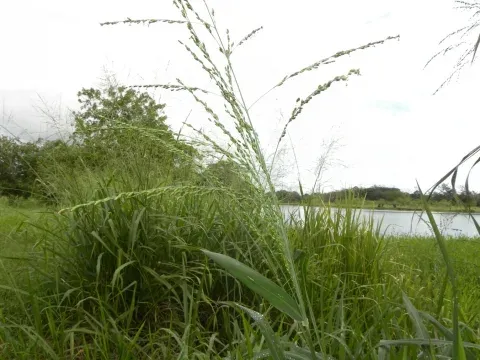
Guinea grass
Panicum maximum
Guinea grass, botanically known as Panicum maximum, is a robust perennial grass belonging to the Poaceae family. Sowing should be carried out when soil temperatures are consistently high, as the seeds require significant warmth to germinate effectively.
What the section contains
Guinea grass
The ideal time for planting is the beginning of the rainy season in tropical areas, or during late spring in subtropical climates. Successful establishment depends on ensuring the seeds have adequate moisture immediately following sowing.
The seeds are small and should be sown at a shallow depth of approximately 1-2 centimeters. Using rows with 40-60 centimeters spacing is recommended to allow for optimal plant development and effective weed control during the early stages.
Seedbed preparation is crucial; the soil should be finely tilled and leveled to prevent seeds from being buried too deeply. Mechanical rolling after planting helps ensure good soil-seed contact, which is essential for uniform germination.
Establishing a dense stand is important to suppress competitive weeds during the first month of growth. If environmental conditions are favorable, the grass will establish a strong root system rapidly, ensuring long-term field persistence.
This grass thrives in fertile, well-drained soils with a pH ranging from 5.5 to 7.5. It is highly responsive to nitrogen fertilization, which should be applied in split doses to sustain its high biomass production throughout the growing season.
Panicum maximum requires significant sunlight for optimal growth. It does not perform well under deep shade, so open fields with high solar radiation are preferred for commercial forage production.
While it is relatively drought-tolerant once established, it needs consistent rainfall or irrigation for high-intensity harvesting cycles. Waterlogging should be strictly avoided as it can cause root rot and decrease plant longevity.
The plant is sensitive to frost; extreme cold can damage the top growth and significantly set back the stand's productivity. In regions with cool winters, management practices must account for dormancy periods.
Regular maintenance including light cultivation and weed management during the establishment phase ensures the crop reaches its full potential. Once the stand is closed, it becomes highly competitive against most common weeds.
Guinea grass is renowned for its high yield potential and nutritional value. Under managed conditions with proper fertilization and moisture, it can produce multiple cuts per season, providing a steady supply of high-quality forage.
Depending on the variety and local management, dry matter yields can range from 15 to 30 tons per hectare annually. Its high leaf-to-stem ratio makes it particularly valuable for cattle grazing and hay production.
The nutritional value is highest when the plant is harvested before reaching the full flowering stage. Delaying the harvest leads to lignification of the stems, which reduces palatability and overall digestibility for livestock.
Longevity of the stand depends on proper grazing pressure or cutting height. With good management, a Guinea grass field can remain productive for many years, though periodic soil nutrient replenishment is required.
Frequent harvests stimulate the plant to produce more tillers, which in turn increases the total yield per hectare. This makes it an ideal candidate for intensive forage systems where maximum output per unit of land is targeted.
Common diseases affecting Panicum maximum include various leaf spot fungi and rusts, which tend to proliferate in high-humidity conditions with poor airflow. Selecting resistant varieties can help mitigate these risks.
Insect pests like stem borers, leafhoppers, and aphids can damage the crop, especially during the early stages of regrowth. Integrated pest management strategies, focusing on biological controls and monitoring, are highly recommended.
Nematodes are a potential threat, particularly in sandy soils. Crop rotation and keeping the soil healthy through organic amendments can help maintain a natural balance and reduce nematode populations.
To keep the crop healthy, farmers must ensure the fields are not over-fertilized, as excessive nitrogen can sometimes make the foliage more attractive to certain pests and susceptible to fungal infections.
Cleaning farming machinery between different fields is a critical practice to avoid transferring pathogens or weed seeds. Biosecurity within the farm helps in preserving the longevity and health of the forage stands.
Harvesting is typically done by cutting the grass just before or at the beginning of the flowering stage. At this developmental phase, the forage provides the best balance between biomass quantity and protein content.
For conservation purposes, the grass can be made into silage or hay. Quick processing is necessary after cutting to maintain the quality of the harvested material and minimize nutrient losses from respiration.
The cutting height should be maintained at about 10-15 centimeters. This ensures the growing points of the plant are preserved, allowing for vigorous regrowth and higher cumulative yields across multiple harvests.
In rotational grazing systems, cattle should be introduced when the grass reaches about 60-80 centimeters in height and moved to the next paddock before the stand is overgrazed.
Monitoring the regrowth intervals is essential. Depending on the weather conditions, the interval between cuts usually ranges from 30 to 45 days. Flexibility in management ensures that the crop stays in a vegetative, highly nutritious state.