
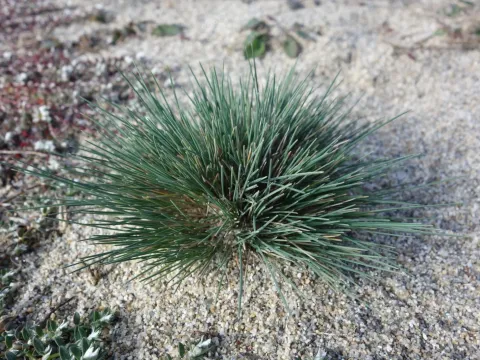
Grey hair-grass
Corynephorus canescens
Corynephorus canescens is a perennial grass species primarily used for stabilizing sandy soils and coastal dunes. Sowing is typically carried out in early spring or late autumn to allow the seeds to benefit from seasonal moisture levels.
What the section contains
Grey hair-grass
The seeds are exceptionally small and require precise sowing methods. Direct drilling or broadcasting with subsequent light rolling is recommended to ensure the seed is properly embedded in the sandy substrate without being buried too deep.
In large-scale reclamation projects, hydroseeding is often employed. This method allows for the even distribution of seeds, binders, and light mulching material, which is critical for preventing wind erosion until the plants establish.
Natural regeneration is common in undisturbed areas. However, for agricultural or land management purposes, manual seeding should be performed at a rate that allows for dense stand establishment, which is necessary for effective soil binding.
Germination is generally slow and weather-dependent. Successful establishment requires a period of cool, moist weather, which is why late autumn planting is often favored in regions with reliable winter precipitation.
As a specialist psammophyte, grey hair-grass is adapted to extremely nutrient-poor, dry, and unstable sandy environments. It is a vital pioneer species that helps initiate soil development in otherwise barren areas.
The plant thrives in full sun exposure. It is highly intolerant of shade and will quickly decline if outcompeted by taller or more vigorous plant species, making it suitable for open habitats only.
Soil requirements are minimal regarding fertility; the plant excels in soils where nitrogen and phosphorus are almost undetectable. It is physically structured to tolerate the high temperature fluctuations typical of open sandy surfaces.
While tolerant of sand movement and burial by shifting dunes, the plant prefers stable conditions once established. It requires excellent drainage and will not survive in waterlogged or heavy clay-rich soils.
Soil pH preference ranges from slightly acidic to neutral. In highly alkaline or saline conditions, the vigor of the grass decreases significantly, limiting its usefulness in certain coastal areas.
Grey hair-grass is notably robust and suffers from very few diseases. The harsh conditions it naturally inhabits inhibit the growth of most common fungal pathogens that affect agricultural grasses.
Pest pressure is also low, as the plant is not a preferred food source for many herbivores due to its wiry texture and low nutrient density. This makes it a low-maintenance choice for sustainable landscaping.
The primary threat to population stability is physical disturbance, such as excessive trampling by humans or livestock. Once the protective root mat is broken, the soil loses its integrity and reverts to an erodible state.
Invasive species competition is a significant threat in areas where soil fertility is artificially improved. As the soil organic matter increases, more competitive grasses often move in, displacing the hair-grass.
There are no major insect outbreaks reported for this species. Integrated pest management for this crop typically focuses on habitat protection rather than chemical applications, which could damage the sensitive sandy ecosystem.