
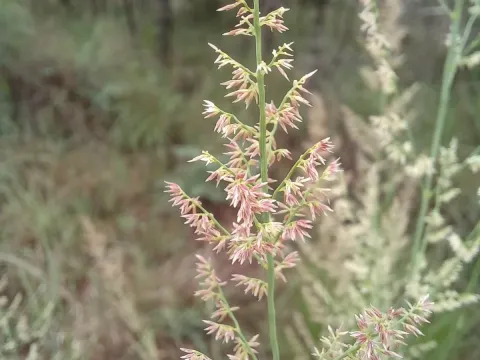
Gum-stick lovegrass
Eragrostis gummiflua
Gum-stick lovegrass (Eragrostis gummiflua) belongs to the Poaceae family and is a perennial grass species recognized for its resilience in arid environments.
What the section contains
Gum-stick lovegrass
Sowing typically takes place during the spring season when soil temperatures reach the threshold required for successful germination.
Due to the small size of the seeds, they should be sown shallowly, ideally at a depth not exceeding 1.5 to 2 centimeters to ensure emergence.
The field must be leveled and cleared of debris to create a fine-textured seedbed that facilitates optimal seed-to-soil contact.
Post-sowing irrigation may be necessary in areas with low seasonal rainfall to support the initial establishment of the root system.
The species originates from Southern Africa and is exceptionally well-adapted to hot, arid climates with frequent periods of drought.
It thrives on sandy and well-drained soils, showing a remarkable ability to extract moisture even from nutrient-poor substrates.
Full sun exposure is a primary requirement for the plant's development; any degree of shade tends to reduce its biomass production significantly.
Its robust root system acts as an excellent soil stabilizer, making it a preferred choice for erosion control projects in sandy regions.
The plant demonstrates high tolerance to soil acidity and alkalinity, allowing it to grow in diverse edaphic conditions across its range.
The primary agricultural use of Eragrostis gummiflua is as a grazing fodder crop for livestock in arid and semi-arid regions.
Yield productivity is maximized through rotational grazing strategies that allow the grass to recover its energy reserves between grazing bouts.
In managed pastures, proper management can ensure a steady supply of palatable green biomass throughout the peak growing season.
The forage quality is considered moderate, providing essential nutrients for ruminants when alternative forage species fail due to heat stress.
Harvesting for hay is possible, though it requires precise timing to ensure the nutritional value of the stems and leaves is preserved.
This grass species is known for its high level of hardiness, showing resistance to most common foliar diseases affecting forage grasses.
Grasshoppers and other orthopterans pose a primary pest risk, potentially causing defoliation during the dry season when other food sources become scarce.
Soil-borne pathogens are rarely an issue unless the soil remains saturated for extended periods, which inhibits root health and overall growth.
Management of weed competition during the seedling stage is critical to ensure that the stand matures without severe interference.
Integrated pest management protocols suggest monitoring for signs of infestation to prevent widespread damage to the pasture stands.