
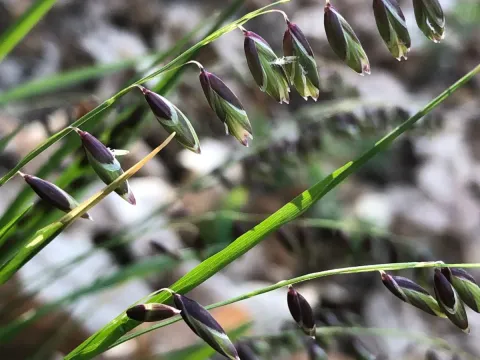
Melic grass
Melica nutans
Melic grass (Melica nutans) is a perennial grass belonging to the Poaceae family. It is primarily found in forest ecosystems across Eurasia, where it has adapted to growing in shaded, moist environments under forest canopies.
What the section contains
Melic grass
The plant is characterized by a creeping rhizome system, which facilitates the formation of a dense turf. This makes it a valuable species for soil stabilization in forestry settings and an effective component for shaded pasture lands.
Melic grass thrives in fertile, well-drained loamy soils. While it prefers moderate moisture, it does not tolerate waterlogging or stagnant conditions, which can lead to root degradation and reduced plant vigor.
The culture is highly shade-tolerant, which sets it apart from many other forage grasses that require direct sunlight. This trait allows for successful integration into agroforestry systems where light availability is limited by tree foliage.
Agronomic management requires monitoring soil pH, as the plant prefers neutral to slightly acidic conditions. Maintaining proper soil structure is essential for root health, enabling the grass to withstand winter temperatures and start early spring growth.
The economic utility of Melic grass is centered on its forage value. It provides a nutritious feed source for livestock, particularly during the early stages of the growing season when nutrient content is at its peak.
Yield capacity is influenced by the density of the sward and the site's overall fertility. Although rarely sown as a monoculture, its inclusion in pasture mixes significantly contributes to the overall biomass production in woodland pastures.
The plant exhibits moderate regrowth potential after grazing or mowing. To sustain long-term productivity, rotational grazing or cutting management is recommended to allow the plant to replenish its carbohydrate reserves in the rhizomes.
Seed production is characterized by asynchronous ripening of the spikelets. Harvesting should be carefully timed to prevent seed shattering, which is a common challenge when collecting seeds for propagation purposes.
In conservation and agronomic programs, Melic grass helps to improve soil structure and prevent erosion. Its root system plays a crucial role in binding soil particles, especially on sloping terrain common in forest edges and foothills.
Common fungal diseases affecting Melica nutans include rust and powdery mildew. These issues often emerge when environmental conditions become excessively humid or when the stand lacks sufficient airflow.
Pests such as cereal aphids and various grass-feeding flies can impact growth by damaging young shoots. Integrated pest management strategies, focusing on site sanitation and proper stocking rates, are the most effective preventive measures.
Root-knot nematodes and other soil-borne pathogens can reduce the longevity of a stand on poor or overused soils. Crop rotation and the selection of high-quality seeds are vital practices to maintain healthy forage populations.
Drought stress increases the susceptibility of Melic grass to both diseases and pest infestations. Ensuring optimal hydration through proper land selection and moisture management is essential to keep the grass healthy during hot summers.
Weed management during the seedling stage is critical. As Melic grass establishes its root system, it can be sensitive to competition from faster-growing invasive weeds, requiring manual or selective mechanical weeding until the stand is fully established.