
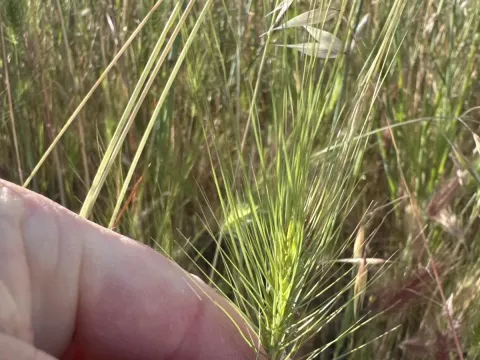
Medusahead
Taeniatherum
Medusahead (Taeniatherum) is a genus of annual grasses belonging to the Poaceae family. In agricultural contexts, it is primarily recognized as a highly invasive weed that can severely degrade pasturelands and crop fields.
What the section contains

Medusahead
Its natural habitat spans across Eurasia, including regions in the Mediterranean and Central Asia. The plant is well-adapted to environments characterized by long, dry seasons and variable precipitation.
Botanically, it is identified by its long, awned spikes that create a distinctive, dense appearance in the inflorescence. The culms are upright, typically reaching heights between 20 and 50 centimeters.
The life cycle of Medusahead begins in early spring, allowing it to complete its growth phase before many other species. Its rapid root development facilitates a strong competitive edge over native or beneficial flora.
The plant exhibits remarkable biological plasticity, enabling it to thrive in degraded soils and environments where moisture competition is high during the vegetative stage.
Medusahead is exceptionally resistant to extreme climatic stress, including high summer temperatures and prolonged drought, which often inhibit the growth of more desirable forage species.
The species has low soil requirements, thriving in various substrates including poor, rocky, or clay-heavy soils. It often dominates in areas where soil fertility is limited.
Optimal conditions for growth include full sun exposure. The plant is highly sensitive to shading, and dense canopy cover from other vegetation can effectively suppress its germination and spread.
Effective agricultural management involves monitoring soil disturbance, as the plant rapidly colonizes newly opened or disturbed ground. Maintaining healthy, competitive forage cover is a key preventive measure.
While adapted to various soil types, Medusahead performs most aggressively in regions with winter precipitation patterns followed by dry spring seasons, which are common in many Mediterranean-like climates.
Medusahead acts as a significant reservoir for various plant pathogens. It provides a sanctuary for diseases that can later migrate to cereal crops, impacting overall field health.
Pests that typically attack wheat and barley often utilize Medusahead as a secondary host. This allows populations of insects to survive in the field during the absence of the primary crop.
The sharp, barbed awns of the plant pose a physical risk to livestock. When present in hay, these structures can cause severe mechanical injury to the mouth, eyes, and digestive tracts of grazing animals.
Invasion by this species leads to significant loss of productivity in rangelands, as it displaces more nutritious forage species, reducing the overall carrying capacity of the land.
Control strategies must be implemented early, as the plant is highly prolific. Managing it requires a combination of prescribed burning, herbicide application, and the establishment of more vigorous, competing vegetation.