
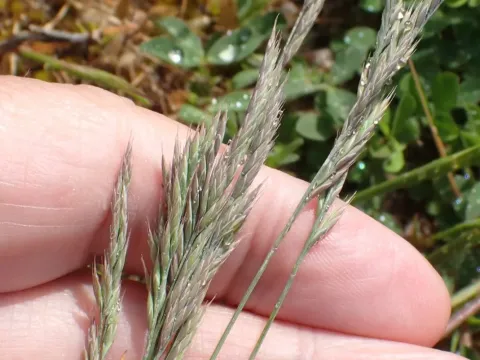
Rush-leaved fescue
Festuca juncifolia
Rush-leaved fescue (Festuca juncifolia) is a perennial grass belonging to the Poaceae family. It is recognized as a hardy psammophyte, a plant adapted to grow in shifting sand dunes and unstable soil conditions.
What the section contains
Rush-leaved fescue
Botanically, it features narrow, rush-like leaves that minimize water loss through transpiration. This structural adaptation allows the grass to thrive in arid environments where other species fail to survive.
The plant requires well-drained, sandy soils with low nutrient content. It exhibits remarkable tolerance to salinity and low moisture levels, making it a key species for ecological restoration projects.
Climate adaptation is a hallmark of this species, as it withstands extreme temperature fluctuations and severe droughts. It remains dormant during the peak of summer heat to conserve energy and moisture reserves.
In terms of agricultural management, the species is not highly demanding but requires full solar exposure. It should not be planted in compacted or clay-heavy soils, which restrict root expansion and water absorption.
The main threats to Festuca juncifolia populations include soil compaction caused by heavy mechanical machinery and overgrazing. Excessive pressure can destroy the delicate structure of the dunes where this plant grows.
Fungal pathogens such as rusts and mildews may appear under conditions of extreme humidity or poor air circulation. Proper spacing during seeding is essential to prevent the spread of diseases.
Insect pests are generally not a significant issue due to the plant's tough, siliceous leaves. However, certain grass-eating insects can cause minor damage during the seedling stage.
Invasive species or aggressive weeds can outcompete the fescue if the soil is artificially enriched with fertilizers. Therefore, maintaining a low-nutrient, sandy environment is the best protection against competition.
Prevention of degradation is key; regular monitoring of plant density and soil structure ensures the longevity of the perennial cover and prevents erosion from gaining a foothold.
Harvesting is primarily focused on collecting seeds for land reclamation. The process begins once the panicles mature and reach a light beige color, indicating that the seeds are fully developed.
Seed collection is delicate because the seeds shatter easily. Using specialized headers or manual harvesting techniques helps to maximize yields and maintain the quality of the harvested material.
Post-harvest processing involves thorough cleaning to remove sand particles and organic debris. The seeds should be stored in cool, dry conditions to preserve their viability for future planting.
For large-scale applications in erosion control, the harvested biomass is sometimes left on-site to act as natural mulch. This layer protects the emerging seedlings from extreme sun and helps hold sand particles in place.
Agricultural professionals emphasize that the main purpose of harvesting is to support future revegetation efforts rather than biomass production for feed, highlighting the plant's ecological importance.