
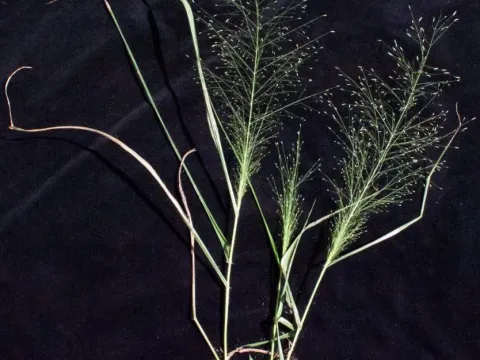
Rough lovegrass
Eragrostis aspera
Rough lovegrass (Eragrostis aspera) is an annual grass species belonging to the Poaceae family, widely recognized for its resilience in warm climate zones. It serves as an essential forage plant in regions where soil moisture is often limited and nutrient availability is suboptimal.
What the section contains
Rough lovegrass
The native distribution of this species spans across the tropics and subtropics of Africa and Asia. It is well-adapted to high temperatures and thrives in environments that receive distinct wet and dry seasons, demonstrating a strong ability to regenerate quickly once moisture levels rise.
Botanically, the plant features erect, slender stems reaching heights of nearly one meter. The leaves are characteristically rough in texture, providing a distinct identifier. The inflorescence is an open, delicate panicle that produces numerous small seeds, allowing for rapid colonization of fallow agricultural areas.
The crop requires full sun exposure and performs best in well-drained soils, though it exhibits significant tolerance to poorer soil conditions. Unlike many high-input forage grasses, it does not require intensive fertilization, making it a sustainable choice for extensive livestock management systems.
Economically, Rough lovegrass is primarily utilized as livestock feed. It provides a reliable source of green forage during the peak of the dry season. Its high adaptability to harsh environments makes it a valuable asset for farmers aiming to secure fodder production in regions prone to drought.