
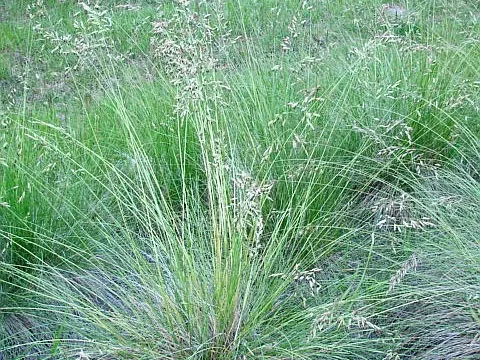
Rough fescue
Festuca scabrella
Rough fescue is a perennial bunchgrass that is primarily established via direct seeding into prepared seedbeds. The ideal time for sowing is early spring or late autumn when soil moisture levels are conducive to germination and early establishment.
What the section contains
Rough fescue
Seeds should be planted at a shallow depth of approximately 1 to 2 centimeters to ensure good soil-to-seed contact. Since the seedlings grow slowly, it is crucial to keep the soil surface moist during the initial weeks to support proper root system development.
The seeding rate typically ranges from 10 to 15 kilograms per hectare depending on the site characteristics and intended use. When used in mixtures, the percentage of rough fescue should be adjusted according to the competitive strength of other species in the mix.
Soil preparation is a critical step that involves thorough tilling and firming to provide a stable medium for growth. Using a seed drill helps achieve a uniform distribution and proper depth, which significantly improves the chances of a successful stand establishment.
Fertilization at the time of sowing, particularly with phosphorus, can promote faster root development. Once established, the grass is highly resilient and does not require frequent reseeding, making it a cost-effective choice for long-term land management.
Rough fescue (Festuca scabrella) belongs to the Poaceae family and is native to regions with cool, semi-arid to temperate climates. It is highly regarded for its ability to thrive in challenging environments where other grasses might struggle.
The plant prefers well-drained, fertile soils ranging from loam to sandy-loam textures. It has a high tolerance for varying pH levels and is particularly well-adapted to the cooler growing conditions found in northern latitudes and mountainous regions.
Sunlight is vital for this species, as it requires open areas to reach its full potential. While it exhibits good drought tolerance, it performs best when provided with moderate moisture throughout the growing season, avoiding extreme waterlogging which can be detrimental.
The grass is exceptionally winter-hardy, capable of surviving harsh frost conditions. Its deep, fibrous root system allows it to efficiently extract nutrients and moisture from the soil, contributing to its overall durability in diverse landscapes.
Management of soil fertility is recommended for maximizing biomass, though it performs acceptably even in moderately nutrient-poor soils. Proper drainage is the most important factor, as the species is sensitive to anaerobic conditions in the root zone.
The primary use of rough fescue is for cattle and sheep grazing, as it provides high-quality forage during the spring and early summer months. It is noted for its palatability before the seed heads emerge and the stems become too lignified.
Management of grazing intensity is essential to maintain the productivity of the stand. Rotational grazing patterns are recommended, allowing sufficient recovery periods for the plants to replenish their internal energy stores in the roots and crown.
For hay production, the harvest must occur before the plant fully matures to retain nutritional value and digestibility. Because of its rough leaf texture, it is often preferred as pasture rather than harvested for hay, but it remains a nutritious option when harvested at the right stage.
With proper management, this species can yield consistently for many years. It is often combined with legumes in pastures to enhance the nitrogen content of the soil and improve the overall protein profile of the forage available to livestock.
Average yields can vary significantly based on environmental factors, typically falling between 15 and 30 decitons of dry matter per hectare. The sustainability of this grass makes it a preferred choice for extensive livestock operations seeking low-input systems.
Common diseases affecting rough fescue include various leaf rusts and fungal leaf spots, which typically appear during periods of high humidity. Improving airflow through appropriate grazing or spacing is an effective cultural control method.
Insects like grass bugs, aphids, and certain soil-borne larvae can occasionally pose a threat by damaging foliage or root systems. Monitoring the pasture for these pests is essential, particularly in the spring when seedlings are most vulnerable.
Preventative measures focus on maintaining a healthy, vigorous stand that can naturally resist infection. Avoiding overgrazing is the most important management strategy, as stressed plants are significantly more susceptible to diseases and pest infestations.
In some instances, if pest populations exceed economic thresholds, selective insecticide applications might be considered, though this is rarely necessary in managed grazing scenarios. Prioritizing biological diversity within the pasture can help mitigate pest outbreaks.
Weed encroachment can be a challenge during the establishment phase, requiring careful monitoring. Once the grass is fully established, its density usually suppresses the majority of invasive weeds, reducing the need for chemical herbicides.