
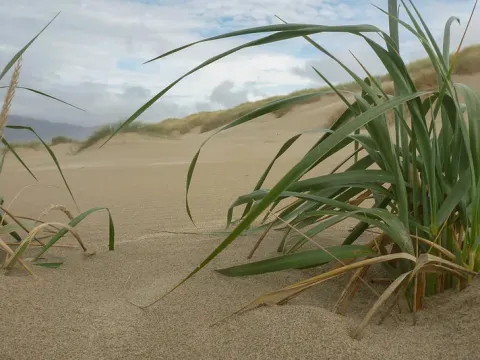
American dunegrass
Elymus mollis
Sowing American dunegrass is most effective during early spring when soil temperatures begin to rise, allowing the seeds to benefit from spring moisture cycles.
What the section contains
American dunegrass
Seeds should be planted at a shallow depth of approximately 2-3 centimeters; this ensures that the emerging shoots can quickly reach the surface in sandy soils without exhausting their energy reserves.
For large-scale dune restoration, mechanical drilling is preferred, followed by firming the soil with heavy rollers to ensure optimal seed-to-soil contact in loose substrates.
Vegetative propagation remains a popular alternative, where rhizome segments are buried at a depth of 5 to 10 centimeters to establish rapid vegetative cover in high-erosion areas.
Strategic timing is essential; planting should be completed well before the heat of mid-summer to ensure the root systems are sufficiently established to withstand potential dry spells.
Belonging to the Poaceae family, American dunegrass is a highly specialized halophyte that thrives in the harsh, salt-laden environments of temperate and arctic coastal zones.
The plant demonstrates remarkable tolerance to saline conditions, sandy soils, and shifting dunes, making it an essential species for coastal protection and landscape engineering.
It prefers well-drained, nutrient-poor sandy soils where it faces little competition from less hardy grasses, allowing it to dominate coastal vegetation zones.
American dunegrass is highly resilient to strong maritime winds and the physical impact of blowing sand, which it utilizes for vigor through periodic burial of its stems.
While it requires consistent moisture to establish, it is adapted to the natural cycles of tidal influence and high humidity typical of coastal northern climates.
Although American dunegrass is not grown for grain production, it serves as a valuable forage source in northern pastoral systems, providing reliable nutrition during the growing season.
Green biomass yields are largely dependent on nitrogen availability, which is generally low in native beach environments, though the grass remains palatable to various livestock species.
When harvested as hay, it is best cut during the late vegetative or early heading stage to maintain a favorable protein balance before the tissue turns coarse and fibrous.
Sustainable grazing management is crucial, as over-harvesting can damage the rhizomatous network, reducing the plant's capacity to stabilize sand and regenerate in subsequent seasons.
In stable conditions, the grass forms dense, high-yielding stands that provide effective erosion control while supporting regional biodiversity in coastal rangelands.
American dunegrass generally exhibits strong resistance to many conventional crop diseases due to its harsh, saline, and wind-swept growing environment which inhibits most pathogens.
Competition from invasive plant species poses the greatest threat during the establishment phase, requiring diligent management to ensure the grass becomes the dominant cover.
Soil pests, particularly wireworms or other subsurface insects, may occasionally affect rhizome health, leading to localized thinning of the grass stands.
Excessive trampling by humans and livestock is a major concern, as it mechanical damages the brittle stems and disrupts the dune's structural integrity.
Climate change and rising sea levels represent long-term threats by encroaching on established habitats and altering the moisture regimes necessary for the plant's sustained growth.