
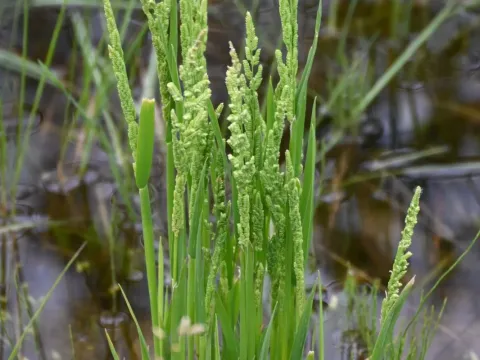
American sloughgrass
Beckmannia syzigachne
American sloughgrass (Beckmannia syzigachne) belongs to the Poaceae family and is a robust perennial forage plant. It is widely recognized for its ability to thrive in wetland environments, making it a valuable crop for river floodplains and areas with high water tables.
What the section contains
American sloughgrass
The optimal sowing time is during early spring when the soil is moisture-rich from snowmelt. This timing is critical as the seeds require consistent moisture for germination and early seedling development. Sowing can also occur in late autumn to utilize natural stratification.
Seeds are typically sown at a depth of 1–2 cm using standard drilling methods. Post-seeding compaction with a light roller is highly recommended to improve contact between the seeds and the damp soil, ensuring uniform emergence across the field.
Seeding rates generally range from 8 to 12 kg per hectare, depending on seed purity and germination rate. Given its slow initial growth rate, it is essential to manage weed competition during the establishment year to ensure the crop takes hold effectively.
Once established, the plant exhibits strong persistence and self-seeding capabilities. This allows the stand to remain productive for many years, reducing the need for frequent re-seeding and contributing to stable perennial forage yields.
This grass is highly specialized for moist conditions. It thrives in marshes, flood-prone lowlands, and along the edges of ponds. Its unique adaptation allows it to survive prolonged flooding for up to 45 days, a trait that makes it superior to many other forage grasses in such habitats.
Soil preferences lean towards rich organic soils, including alluvial deposits and peat. While it prefers neutral to slightly acidic pH levels, it is generally tolerant of various soil types as long as the water regime remains stable throughout the growing season.
As a cold-hardy species, it is well-adapted to cooler temperate climates. It begins its growth cycle very early in the spring, often as soon as the ground thaws, providing an early source of green forage before other warm-season grasses start growing.
While tolerant of waterlogged conditions, the plant is sensitive to severe drought. Prolonged summer dryness can lead to reduced productivity and thinning of the stand. Adequate moisture management is, therefore, the primary factor for successful cultivation.
Fertilization, particularly with nitrogen, can significantly boost biomass production. On well-managed floodplains, applying phosphorus and potassium can also enhance the plant's root development and increase its overall cold and stress tolerance.
The biomass yield of American sloughgrass is impressive under suitable conditions, with reports indicating harvests of 20 to 35 tonnes of green mass per hectare. Its high productivity is largely linked to its efficient use of moisture and nutrient-rich flood-prone soils.
Nutritionally, it is an excellent forage source. Livestock show a strong preference for the grass due to its high palatability and nutritional profile, especially when harvested at the right stage of development. It serves well both as fresh pasture and as high-quality hay.
The best time to harvest is during the early flowering stage. Delaying harvest significantly beyond this period causes the stems to become coarse and lignified, which reduces their digestibility and overall nutrient value for livestock.
In grazing scenarios, the plant recovers reasonably well if managed properly. It is important to implement a rotational grazing system that allows for adequate recovery periods, ensuring the plants can store sufficient energy in their rhizomes.
With proper management, stands of American sloughgrass can remain productive for 7 to 10 years. Consistent monitoring of soil moisture and periodic fertilization helps sustain these yields, making it a reliable perennial crop for wetland grazing and hay production.
American sloughgrass generally possesses a robust immune system. It is not prone to many of the common diseases that affect dryland cereals. However, in overly dense stands or conditions of stagnant air and high humidity, fungal issues like rust can occur.
Pest pressure is usually minimal compared to other cultivated grasses. While insects like the frit fly may occasionally appear, they rarely cause economic damage in healthy, well-managed fields. Standard integrated pest management is usually sufficient.
The greatest threat to its longevity is often competition from more aggressive, less desirable wetland flora such as sedges. If water levels fluctuate uncontrollably, these weeds can outcompete the sloughgrass, necessitating management interventions.
Winter injury, though rare, can happen if ice sheets persist on flooded fields for extended periods during early spring. Most healthy stands recover once the water drains, but severe thinning might require minor overseeding to maintain density.
To prevent disease and weed encroachment, farmers should maintain appropriate seeding densities and ensure that the fields are harvested regularly. A vigorously growing stand is the best defense against pests, pathogens, and invading competitive species.
Hay harvesting should coincide with the flowering stage to maximize nutrient quality. Because harvesting occurs on moist ground, farmers must be prepared for the logistical challenges of drying the biomass, often requiring multiple turnings to ensure uniform moisture reduction.
For seed production, harvesting should be done when the inflorescences show a brownish maturity. Given the high risk of seed shattering, precision in timing is vital; harvesting during cooler parts of the day can minimize loss.
Post-harvest cleaning is essential to remove organic debris and weed seeds. The material should be dried in well-ventilated areas to a moisture content of 12-14% to ensure it can be safely stored without mold or loss of germination potential.
The regrowth (aftermath) following the primary hay cut is an excellent resource for late-summer grazing. Integrating grazing with hay production maximizes the land's utility and provides a continuous feed supply for livestock throughout the season.
Proper storage of hay in weather-proof structures is mandatory to preserve the feed quality. When stored correctly, American sloughgrass hay retains its nutritional integrity, providing a consistent source of energy for livestock during winter months.